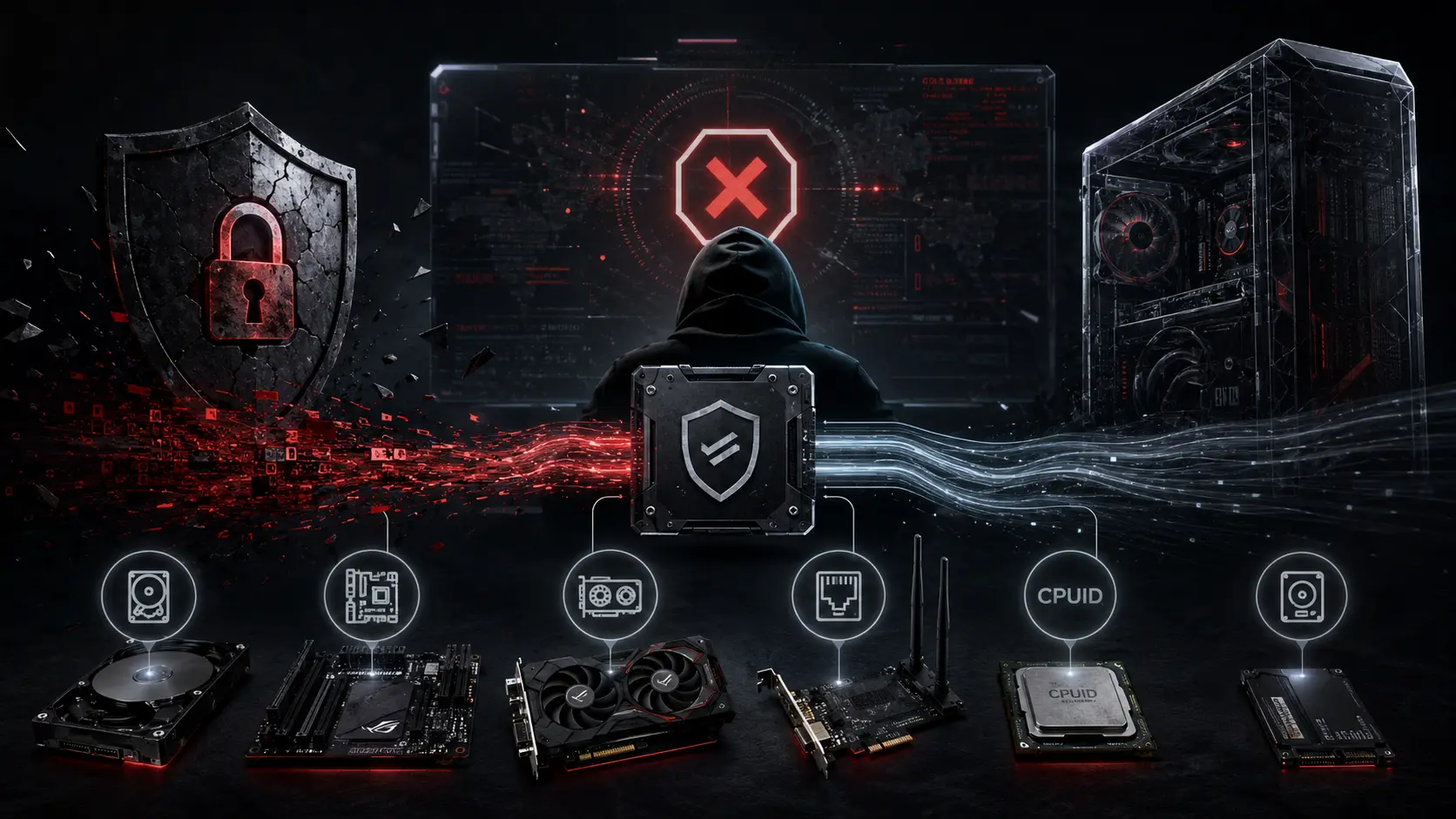
What a hardware ban actually is
When a game bans your account, it bans a string in a database. Delete the account, make a new one, log back in. The game has no way to tell the difference. A hardware ban is the step publishers add after they realize account bans alone are not stopping anyone.
A hardware ban attaches the ban to the machine rather than the login. The anti-cheat records a fingerprint of your hardware during the banning process and writes that fingerprint server-side. Every new account that logs in from a machine producing the same fingerprint inherits the ban immediately, usually within a few minutes of the first match. The account was never flagged. The hardware was.
That distinction matters more than it seems at first. It means the route back is not a new account. It is a different fingerprint.
What anti-cheats read and why deleting registry keys fails
The instinct most players have when they hear "hardware ban" is to clear the obvious registry entries: MachineGuid, the product ID strings, maybe the telemetry IDs. That instinct is wrong, and acting on it alone will not unban the machine. Modern anti-cheats read from multiple sources simultaneously, and registry keys are the easiest layer to substitute, so vendors go deeper.
| Identifier | Source | Editable without spoofer |
|---|---|---|
| MachineGuid / InstallationID | Windows Registry (SOFTWARE\Microsoft\Cryptography) | Yes, manually |
| Disk Serial Number | Reported by firmware via IOCTL_STORAGE_QUERY_PROPERTY | No, reads from firmware |
| Volume GUID / Partition ID | NTFS master boot record, not the registry | No, requires disk tools |
| MAC Address | Network adapter hardware, OS layer only exposes it | Partial, adapter-level only |
| CPU CPUID string | Processor instruction, immutable by software | No, requires kernel interception |
| GPU Device LUID / PCI identifiers | Direct driver query, bypasses OS string caching | No, kernel layer required |
| SMBIOS serial strings (motherboard, chassis) | Firmware table read at boot, stored in physical ROM | No, requires kernel spoof |
The cells marked "No" are what a registry cleaner misses entirely. Disk serials come directly from the drive's firmware over the storage controller bus. CPU identifiers are returned by the processor itself in response to a CPUID instruction. SMBIOS tables are burned into the motherboard's ROM chip. None of these change when you edit the registry. An anti-cheat that cross-references firmware-sourced IDs against the registry values it sees can detect substitution even if you change both, because the low-level and high-level reads should always match.
The gap between what the registry shows and what the hardware actually reports is exactly what a kernel-level HWID Spoofer closes.
How spoofing works at the driver level
A HWID Spoofer does not change your hardware. It intercepts the queries that go to your hardware and substitutes a different answer before the requesting process sees it. The disk has the same serial it had at the factory. The spoofer sits between the query and the response and delivers a different value every time the anti-cheat asks.
The spoofer runs as a kernel driver, which means it operates at the same privilege level as the operating system itself. At that level it can hook the driver dispatch routines that handle storage queries, network adapter enumeration, and processor identification calls. When the anti-cheat driver sends an IOCTL query down the device stack asking for a disk serial, the spoofer's hook intercepts that IRP (I/O Request Packet) before it reaches the actual storage driver, fills the response buffer with a generated value, and completes the request. The anti-cheat driver receives a valid-looking serial that does not match the banned fingerprint.
Consistency matters here. The generated values have to be stable across the session. If the disk serial changes between the first query and the second query the anti-cheat sends, the mismatch is detectable. A good spoofer seeds its generated values once per boot and holds them fixed for the entire session.
How deeply each anti-cheat goes into hardware
Not every anti-cheat collects the same set of identifiers, and not every game enforces hardware bans at all. The depth of collection determines what the spoofer has to cover.
Vanguard's position at the top is not accidental. It is a kernel-level driver that loads before Windows boots on systems requiring TPM and Secure Boot. The early load position gives it first access to hardware data before any user-mode process has a chance to intercept queries. Spoofing Vanguard requires the spoofer kernel driver to also load before Vanguard initializes, which means boot order sequencing is part of the implementation. Builds that do not handle this correctly lose the race and deliver spoofed identifiers only on subsequent queries, after the original fingerprint has already been recorded.
VAC's lower score reflects Steam's design choice to keep VAC as a detection tool rather than a hardware enforcement mechanism. VAC bans are account-level in the vast majority of cases. Hardware action in CS2 typically comes from Valve's manual review team, not from VAC automation.
Permanent spoofing vs session spoofing: the real difference
The terminology in most guides is loose, so the distinction gets lost. Both produce a clean hardware fingerprint during a game session. The difference is what happens to traces left on disk after the session ends.
// Spoofing method comparison
Session spoofing is the standard method in legitimate HWID Spoofer products. The driver loads at boot, intercepts all hardware queries for the duration of the Windows session, and unloads cleanly without writing anything permanent to hardware. The real serial numbers remain unchanged on the drive and motherboard. This matters because firmware writes can brick hardware if done incorrectly, and because anti-cheats that read firmware directly during the next session would detect the discrepancy between a written fake serial and the actual SMBIOS values elsewhere.
The cleaner step is what separates a session spoofer that works once from one that works reliably over time. Anti-cheats collect more than real-time hardware reads. They log installation paths, telemetry files, crash dumps, and event logs that contain hardware context from previous sessions. If those traces carry your banned fingerprint, a fresh spoof on the new account still produces a match during log analysis. Session spoofing without cleaning the trace history is the most common reason players get re-banned within the first week.
The cleaner step most guides skip
Every HWID ban leaves a trail beyond the hardware fingerprint itself. Anti-cheat telemetry writes local log files. Windows event logs record device serial strings during enumeration. Game installation paths, user data folders, and shader caches all contain identifiers tied to the original account and hardware context. These are the files the anti-cheat references when a new account logs in, before the spoofer has even had a chance to run.
A proper trace cleaner removes or randomizes those artifacts before the first new-account session. The targets vary by game but the categories are consistent: telemetry databases, crash reporter caches, GPU shader caches (which contain driver version and device ID strings), Windows event log entries referencing hardware serials, and game-specific installation registry keys that include machine context. Cleaning shader caches in particular is often skipped because players assume they only affect performance. For Valorant and similar titles that log GPU device identifiers in the shader cache metadata, skipping it leaves a direct fingerprint link between the banned session and the new account.
The cleaner runs once before the new account logs in for the first time. After that, the spoofer handles real-time identifier substitution for every session going forward. Both components are necessary. Neither works reliably without the other.
What fails and why
The category of "HWID Spoofer" covers a wide range of actual implementations, from kernel drivers that intercept every relevant query to registry editors packaged with a misleading name. Knowing what to look for saves accounts.
The most common failure mode is incomplete coverage: a spoofer that handles disk serials and MachineGuid but leaves SMBIOS and GPU identifiers untouched. The anti-cheat collects the full fingerprint, the spoofer covers two of seven fields, and the ban triggers on one of the five it missed. This is not a detection event. The spoofer was simply not intercepting the right queries.
The second failure mode is load order. A spoofer driver that initializes after the anti-cheat has already completed its hardware snapshot delivers a spoofed fingerprint for queries that happen after initialization but does not affect the fingerprint already recorded. The anti-cheat sees the original hardware on first read, then spoofed values on subsequent reads. That inconsistency is itself a signal.
The third failure mode is missing cleaner integration. A technically correct spoofer covering all seven identifier categories still fails within a week if the trace cleanup step was skipped. Log analysis runs retrospectively. The ban does not come during the spoof session. It comes two days later when the telemetry batch is processed server-side and the log entries from the original banned session are matched against the new account's first login context.
A HWID Spoofer that handles all three, full identifier coverage, correct load sequencing, and integrated trace cleanup, is what the ZhexCheats HWID Spoofer is built around. The driver covers disk, SMBIOS, GPU, MAC, and volume identifiers; loads before anti-cheat initialization on supported titles; and ships with a cleaner that targets the trace categories above. For games running BattlEye or EAC, that combination closes the re-ban window to effectively zero on a clean first session.
The seven identifiers in the table above cover what a driver-level spoofer can intercept. Two components outside that list, the monitor and the RAM module, get fingerprinted through entirely different channels and need a different fix. See Hardware Bans Explained for how EDID and SPD serials work and why they need physical hardware rather than a driver hook.
// More articles
 Game Hacking Guides
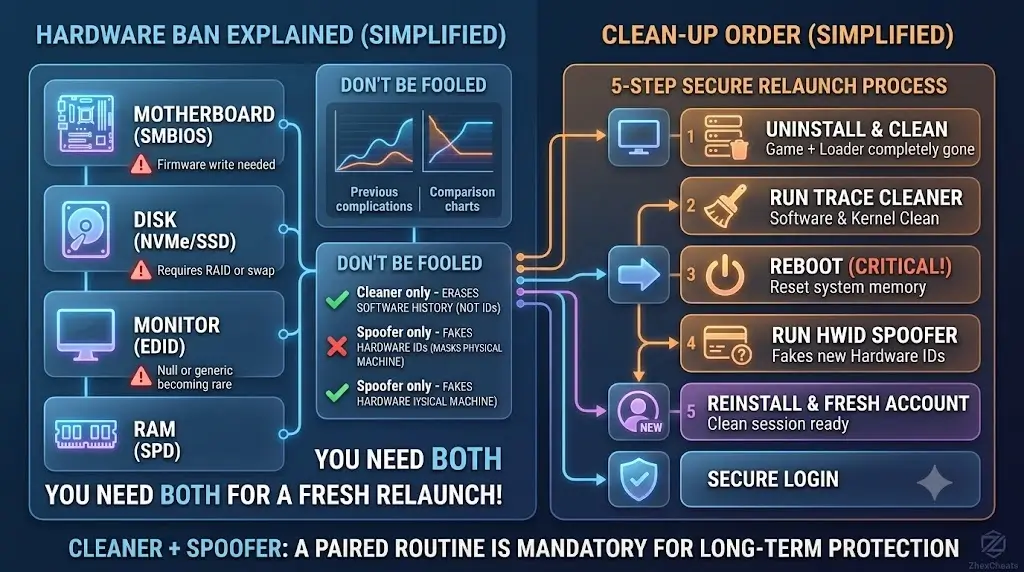
Hardware Bans Explained: Why a Software Spoofer Is Not Enough
A hardware ban fingerprints eight different components, from motherboard SMBIOS to monitor EDID. Here is what each layer actually checks and what closes the gap.
Jul 14, 2026Nathan ReedRead article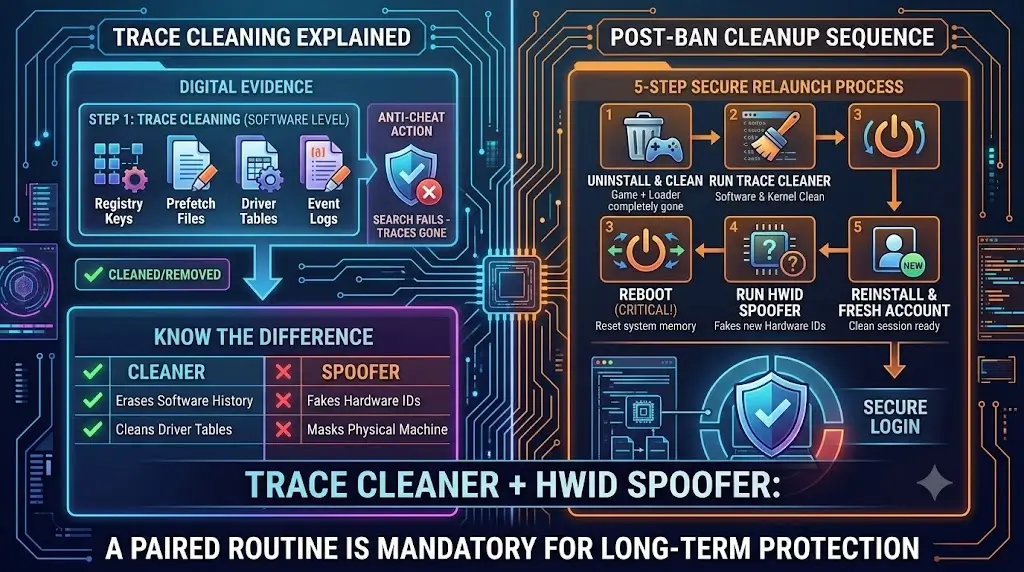 Game Hacking Guides
Trace Cleaning Explained: What Stays on Your PC After a Ban
Registry keys, prefetch files, driver load history: the records anti-cheat reads after a ban, and why a cleaner and an HWID spoofer are not the same tool.
Jul 14, 2026Nathan ReedRead article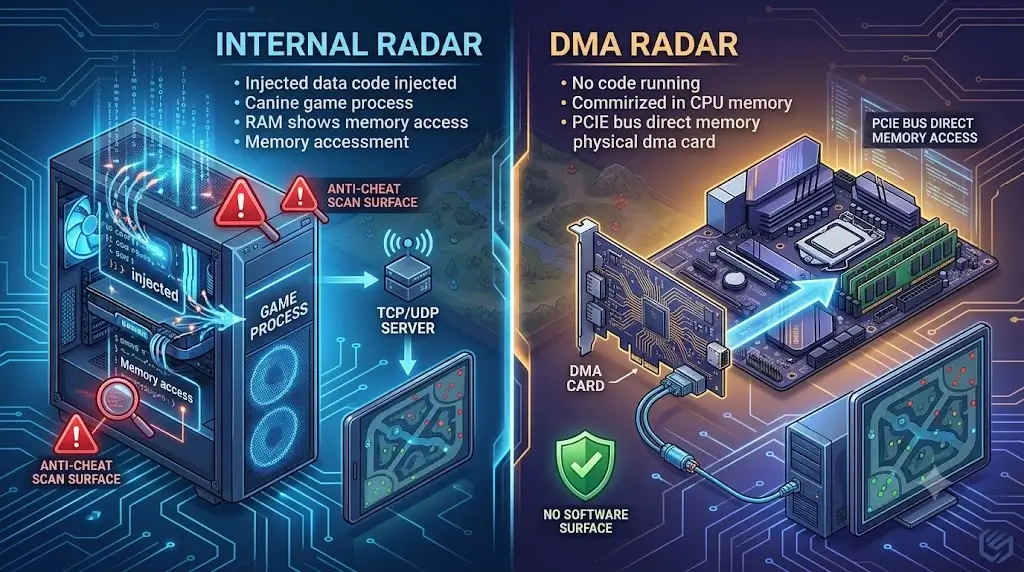 Game Hacking Guides
Radar Hack Explained: How the 2D Map Reads Every Player Position
A radar hack draws a second map that shows every player on the server in real time, without touching the game's renderer. Here is how it actually works.
Jul 12, 2026Nathan ReedRead article Game Hacking Guides
How to Read a Cheat Vendor's Ban History (And Spot Fake Logs)
Days-undetected counters, patch logs and testimonials are trivial to fake. The eight signals that separate real vendors from rebranders.
Jul 11, 2026Nathan ReedRead article