What a radar hack actually is
A radar hack draws a second map on your screen, separate from anything the game renders, that shows every player's position in real time. Not just teammates. Not just nearby enemies. Everyone on the server, through every wall, across the entire map, at all times.
The game's own minimap only ever shows what your character can see or what your squad has spotted. The radar hack ignores those rules entirely. It reads the position data directly from memory and draws it onto a window that runs alongside the game, usually a small overlay in a corner of the screen, sometimes a phone or tablet connected by network.
This is why radar hacks have lasted in competitive gaming for as long as they have. You are not telling the game to render anything differently. You are not injecting aimbot vectors. You are reading a coordinate list and drawing dots. The behavior looks, from the outside, like a player with excellent game sense. That distinction matters more than most people think.
Radar versus ESP: two different layers
Most people group radar hacks and ESP together as the same thing. They are not. The difference is in where the information gets drawn and how the game's rendering pipeline is involved.
The practical upshot is that radar gives you the same positional awareness as ESP without touching anything the game can observe through its renderer. An ESP box on a player who rounds a corner is drawn by your cheat onto the game's frame buffer. A radar dot for the same player exists only on a separate window or device the game cannot see at all.
That separation is why radar hacks stayed in use on games that effectively killed mainstream ESP. On titles with strong overlay detection, radar running on a phone connected to a local network server is completely out of scope for anything the anti-cheat can scan.
How the radar reads position data
Every multiplayer game maintains a list of active entities in memory. Entity in this context means any object with a position: players, vehicles, loot crates, whatever the game engine tracks. Each entity entry carries, at minimum, X, Y, and Z coordinates updated as the entity moves.
The radar hack finds the base address of this entity list, iterates through each entry, filters for the entity types it cares about (players, usually), reads the coordinates, and maps them to pixel positions on its own 2D canvas. The math is simple: take the X and Z coordinates (horizontal plane), scale them to the canvas size, and draw a dot.
Nothing in that process involves drawing into the game's frame. Nothing interacts with the game's renderer, its sound system, or its input handling. The radar process opens a read handle to the game process, reads memory at known offsets, and writes pixels to its own window. From the game's perspective, no external actor touched its rendering pipeline.
The offsets change with every game patch. Finding them again after a patch is the primary maintenance task for a radar cheat developer. That is also the main reason a paid radar service stays ahead of a free one. Updated offsets within hours of a patch mean the radar works again before most players notice a patch dropped.
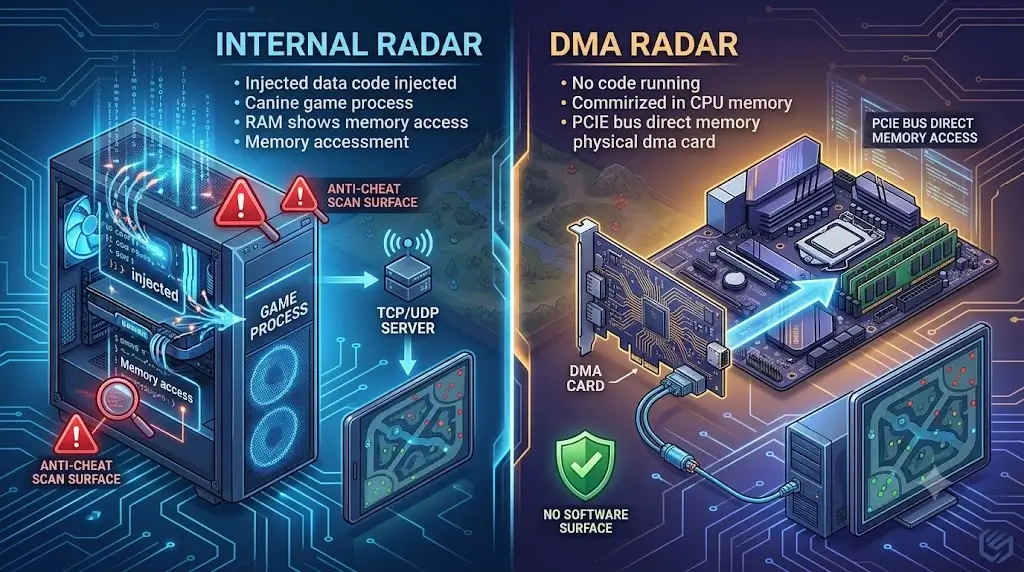
Internal radar versus DMA radar
There are two ways to get the position data out of the game's memory. The method matters for detection risk and hardware requirements.
// HOW EACH APPROACH READS GAME MEMORY
INTERNAL RADAR
Injection = anti-cheat scan surface
DMA RADAR
No code runs on the game PC at all
With an internal radar, the cheat process opens a handle to the game. That handle is visible to any anti-cheat scanning the handle table. The injection itself leaves traces. The network socket broadcasting coordinates is another artifact. None of these things are invisible; they just need to be caught.
With a DMA radar, the read happens at the hardware level, over the PCIe bus, by a card that the operating system sees as legitimate hardware (a network card, a development tool, whatever the card presents itself as). The game PC never has a cheat process on it. No injected DLL, no suspicious handle, no extra socket from an unsigned binary. The anti-cheat scans the game PC and finds nothing, because nothing is there.
DMA radar is the category that has grown fastest over the last two years. The hardware cost is real (a decent DMA setup runs several hundred dollars), but for games with serious anti-cheats, it is currently the only radar solution with a long operational lifespan.
How anti-cheat detects a radar
Detecting a radar hack is harder than detecting an aimbot. An aimbot leaves behavioral traces: inhuman flick speeds, lock-on patterns, statistically impossible headshot rates. A radar leaves almost none of those. A player using only a radar still aims with their own hands, still misses shots, still makes mechanical errors. The radar just ensures they never get surprised.
What anti-cheat systems can look for is the data access side, not the behavior side.
For an internal radar, the signatures are the same as any injected cheat: foreign DLL in the module list, suspicious handle opened against the game process, network traffic from an unsigned binary on known cheat ports. BattlEye and EAC scan for all of these. A well-built internal radar obfuscates its presence, but the surface still exists.
For a DMA radar, there is no software surface to scan. Anti-cheat engineers have pushed into hardware-side detection instead: looking for PCIe devices with unusual firmware signatures, checking DMA remapping tables, comparing the number of PCIe endpoints against a baseline. Not impossible. Not yet reliable across the range of DMA hardware in use. Currently, no major anti-cheat has deployed consistent hardware-side DMA detection at scale. That state of affairs will not last indefinitely, but it is where things stand in 2026.
Which games radar works best in
Radar value is not equal across games. The games where positional awareness matters most, where knowing someone is flanking 200 meters away changes what you do right now, are the games where radar provides the highest advantage.
// RADAR VALUE VS INTERNAL DETECTION RISK, BY GAME (2026)
Bar length = relative risk level. Blue = DMA detection risk. Red = internal radar detection risk.
Escape from Tarkov is where radar provides the most obvious advantage. Raids are long, maps are large, and knowing that a three-man squad is rotating through Resort while two more are pushing from the east changes your entire game plan. The information advantage is enormous compared to a game like CS2, where every map is small enough that sound alone can tell you most of what you need.
PUBG sits just below Tarkov on radar utility. Large maps, unpredictable rotations, and the final circle forcing movement mean positional awareness at distance is constantly relevant. PUBG cheats with an integrated radar component are consistently the most-requested configuration in the ZhexCheats catalogue.
Tarkov cheats at ZhexCheats include radar as a standard feature on higher-tier builds, precisely because the map size makes it the single most impactful thing you can have. Arena Breakout's dual anti-cheat setup makes internal radar riskier than on PUBG or Tarkov; for that title, the internal versus DMA breakdown is worth reading before you buy.
What to know before buying
A radar hack is one of the lower-profile tools you can run. No aimbot lock-on, no instant headshot rate, no movement that a replay system can flag as physically impossible. The behavioral signature is just a player who is never out of position and never gets surprised. That is a real advantage and a meaningful safety property.
The two things that end radar subscriptions early are patch-broken offsets and hardware detection (for internal builds). A vendor whose offset update cadence is slow means the radar is down for days after every patch. That matters more for Tarkov than for PUBG; Tarkov patches frequently and unpredictably.
For DMA radar specifically, the hardware setup is a one-time cost, and the ongoing cost is the software subscription. The DMA card itself does not get banned; only the software reading from it does. A banned radar subscription means you buy access again, not new hardware.
Check the build status page and the last patch date before committing to a subscription. For a game with weekly patches, a radar that was last updated three weeks ago is probably not working right now. The ban history guide covers exactly how to read those numbers before you buy.
// More articles
 Game Hacking Guides
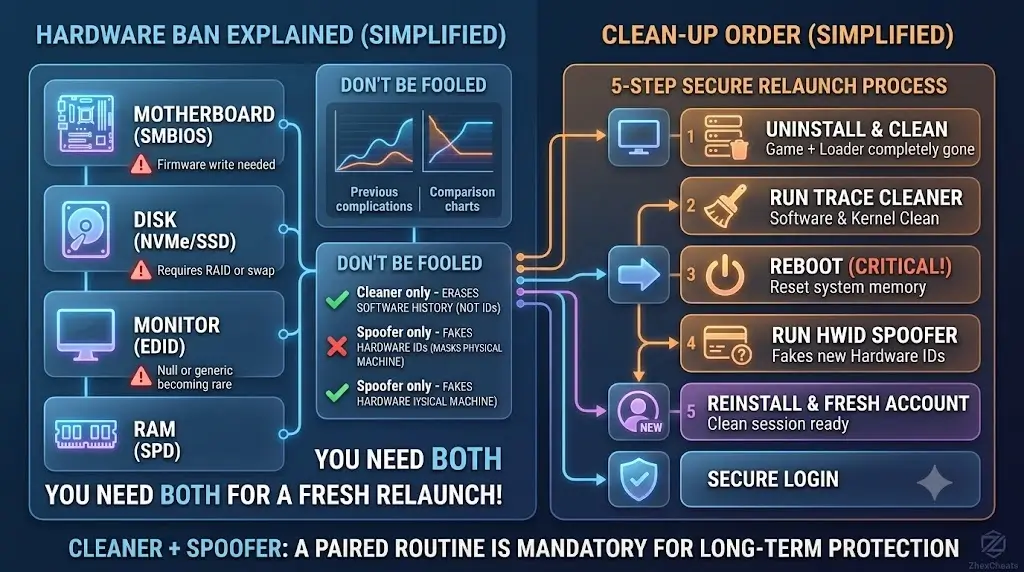
Hardware Bans Explained: Why a Software Spoofer Is Not Enough
A hardware ban fingerprints eight different components, from motherboard SMBIOS to monitor EDID. Here is what each layer actually checks and what closes the gap.
Jul 14, 2026Nathan ReedRead article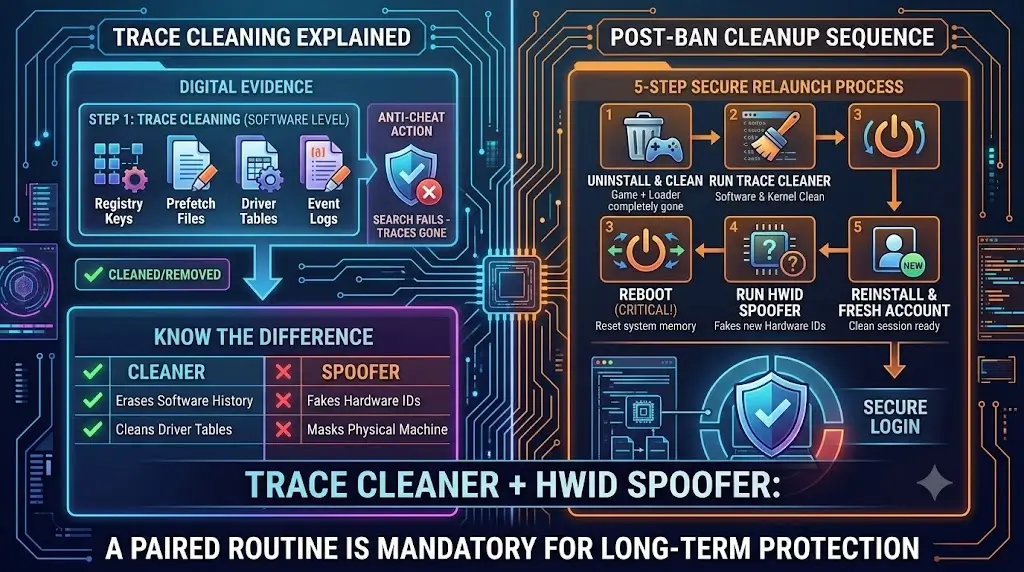 Game Hacking Guides
Trace Cleaning Explained: What Stays on Your PC After a Ban
Registry keys, prefetch files, driver load history: the records anti-cheat reads after a ban, and why a cleaner and an HWID spoofer are not the same tool.
Jul 14, 2026Nathan ReedRead article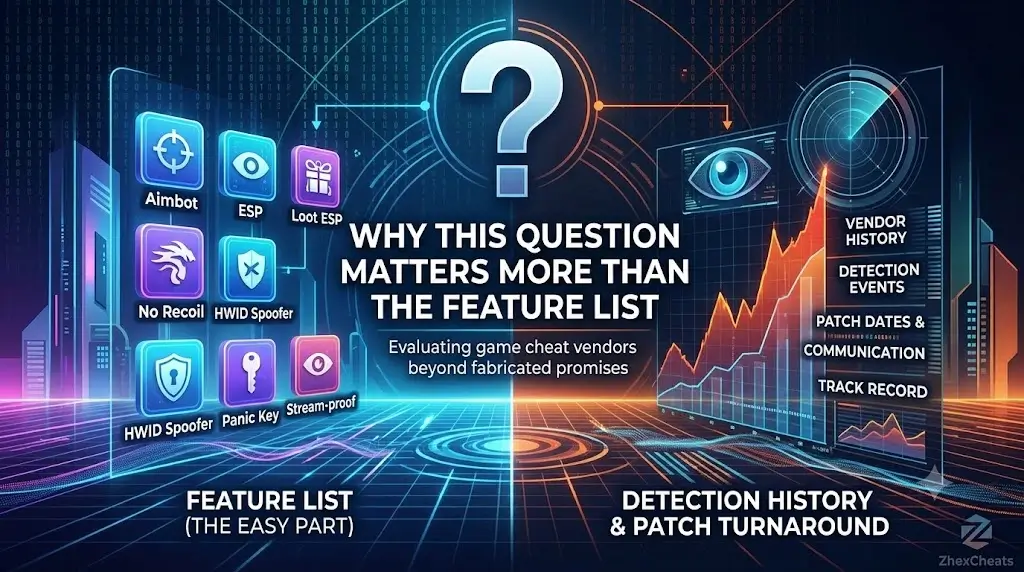 Game Hacking Guides
How to Read a Cheat Vendor's Ban History (And Spot Fake Logs)
Days-undetected counters, patch logs and testimonials are trivial to fake. The eight signals that separate real vendors from rebranders.
Jul 11, 2026Nathan ReedRead article Game Hacking Guides
Kernel Cheats Explained: What Ring 0 Means in 2026
Ring 0 is where anti-cheat lives. A cheat that stays in user mode is fighting from outside a locked room. Here is what kernel access actually means.
May 31, 2026Nathan ReedRead article