
C
Callum_B
Aug 27, 2026
No stutters, nothing weird in Task Manager, overlay is clean. Two hundred odd matches and not one warning.
Black Ops 7 multiplayer plays differently when Ricochet doesn't see you. Our BO7 aimbot, full ESP and zero-recoil ship with HWID safety baked in for MP, Warzone and Zombies.
// In-Game Footage
Real gameplay recorded with our cheat running live. Aimbot, ESP and every feature, captured straight from actual matches. No edits, no fakes, no staged clips.
// Features
Every module included in your subscription, tested daily against the latest anti-cheat updates.
// Plans
Subscription tiers built around how you actually play. Pay with card or ZPoint balance, refund policy on every plan, no auto-renewal traps.
// Get Started
Pick a tier, pay with card or ZPoint balance, loader downloads on confirmation. No email verification gates, no document upload, no waiting period.
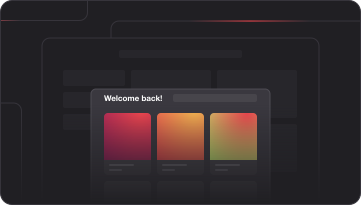
After checkout your loader is ready in seconds. No config files, no manual setup, a single click installs everything and you're good to go.
// Why ZhexCheats
Live support every hour, daily testing against Ricochet, refund if a Black Ops 7 build ever fails.
Real humans on Discord and on-site chat, every hour of every day. Patch nights included.
Ricochet pairs a kernel driver with server-side analysis. Every Black Ops 7 build is verified against both, season after season.
Black Ops 7 patches verified within hours, status page shows live build state for every product.
If the cheat does not work on a current Black Ops 7 patch, the balance comes back. Plain English policy.
// Reviews
Callum_B
Aug 27, 2026
No stutters, nothing weird in Task Manager, overlay is clean. Two hundred odd matches and not one warning.
silent_dom
Aug 23, 2026
distance tags on the player esp changed how i play domination completely. i just know where the rotate is coming from now.
Marek_S
Aug 14, 2026
Multiplayer is where I use it most and the spawn awareness alone has doubled my score per minute. Zombies high rounds are a lot less stressful too when you can see the horde forming before it reaches you.
vaultbreaker99
May 8, 2026
Running this on BO7 for about 6 weeks now and Ricochet hasn't touched me once. The aimbot smoothness slider is what sells it. killcams look completely legit. Been using it in ranked and my lobbies have no idea.
nocturnalfps
May 5, 2026
Zone is the only cheat I've kept a subscription going on for more than 2 months. Every major BO7 patch gets a fix within 24 hours, sometimes faster. Support answered my Discord ticket in under 10 minutes on a Saturday. That kind of reliability is rare.
ricochet_dodge
May 1, 2026
Four weeks on BO7 multiplayer with Ricochet running hot and still clean. The aimbot is smooth on controller settings too, not just M+K. Hardpoint and Domination matches feel effortless.
// FAQ
Common questions about this cheat, how it works, and what to expect.
Ranked Play sits on the same Ricochet pipeline as core multiplayer, so the detection surface is identical on a technical level. Ranked lobbies do attract more manual reports because the player base is smaller and the eyes on each match are sharper. Private builds clear both queues consistently, and the panic key is the layer that handles a sudden spectator who decides to record you. Keep the FOV reasonable and the snap dialed in, and Ranked plays the same as casual on this loader.
Warzone BR and Resurgence both run on the shared Activision client, and the build is verified on every Warzone map in the current rotation before release. Resurgence is where most customers spend their time because the respawn rhythm rewards aggressive pushes that the BO7 Aimbot handles cleanly. Long-range BR engagements work the same way with a bone selector on head or upper chest. The undetected rate on Warzone matches the multiplayer side because the same private loader covers both queues.
Zombies on Black Ops 7 reads the same overlay stack that multiplayer and Warzone use, including the Dark Aether maps. ESP marks every special enemy, the boss spawn zones, and the wonder weapon containers, which turns a four-hour Easter Egg run into a clean afternoon. Solo and co-op sessions both work, and progress saves the same way they would on a vanilla client. Nothing about the cheat changes the camo or weapon XP path.
Ricochet counter-measures fire when the detection system thinks it has a soft signal but not a clean ban-ready one. On a private build with active patch coverage, a damage shield or cloak event is rare because the loader is not on the public signature list that those traps target. If a counter-measure ever does trigger, the panic key kills the build immediately and live chat will walk through whether the account should sit for a few days before the next session.
For a clean main on a clean rig, the bundled spoofer on the lifetime tier is enough to handle a worst-case future flag. Players coming off a previous Activision hardware ban should run the spoofer before the first login on the new account, even with a fresh Activision email. The trace cleaner scrubs the residual system logs that would otherwise tie the new account back to the old machine fingerprint.
Mid-season updates usually settle in twelve to twenty-four hours, with the status page calling the loader state in real time across that window. Season transitions can stretch to twenty-four or forty-eight hours because Activision tends to rotate gunsmith and anti-cheat changes on the same night. Live chat stays open through both windows, and the dashboard reflects the live build the second testing clears.
Radar in S and D is one of the most-used modules on this build because round timing decides the match. The mini-map overlay is tuned to match the resolution and refresh of the in-game UAV style, so a stream viewer reads it as map awareness rather than a hard tell. Pair it with a sensible crosshair placement and the round-by-round pace looks like a sharp comms player. Headphones still help, but they stop being load-bearing.
Refunds cover any product that was paused or down at the moment of purchase, provided no usable time was logged on the loader. ZPoint balance refunds post back to the wallet inside minutes, so a customer can buy the next available product the same evening. Card network refunds run on a longer cycle, but live chat will start the process without a ticket queue.
You opened this page because the lobby is sweating and the TTK is short. Black Ops 7 cheats from ZhexCheats are tuned for exactly that fight. Private builds. Loaders checked every shift. A team that has shipped Black Ops 7 hacks and Call of Duty builds across every Ricochet wave since the system rolled into Warzone, not since the BO7 launch trailer dropped. The undetected record on Black Ops 7 cheats is built on small details and a refusal to ship a shaky build.
Most stores will let a flagged loader sit on the product page over a weekend. ZhexCheats will not. If a Black Ops 7 hack starts behaving wrong in internal testing on a Friday night, the listing goes red before anyone can checkout. That single rule has kept the Black Ops 7 cheats lineup honest and saved more accounts than any glossy feature reel. Live chat runs through every patch night, and the refund policy is in plain words instead of buried legalese.
Reputation is the actual product here. One bad season and the regulars are gone. That is exactly why the BO7 cheats catalog stays tight, curated, and tested on live SBMM lobbies by staff who actually grind Ranked Play with the build before it ever shows up on a customer dashboard.
The BO7 Aimbot locks the bone of your choice and finishes engagements before the other player can finish the burst. Black Ops 7 multiplayer punishes hesitation, and head-glitch positions decide who holds the lane. With the bone set to head or upper chest, an AK-74 turns a close flick into a one-burst kill, and a Kar98k or XPR-50 holds the head box on a wide stretch with quiet tracking. Sweaty SBMM lobbies stop feeling like a coin flip. Your first mag does the work, and your second mag is reload practice.
BO7 ESP paints every hostile on the map through every wall, smoke, and broken sightline. Name tags, current health, distance, and the weapon being carried sit on each silhouette in real time. Hardpoint rotations stop being a guess; you already know which side the four-stack is loading into before the timer flips. In Warzone Resurgence, the gulag camper holding the corner is lit before you peek. On a Dark Aether Easter Egg run, the special spawns are mapped before they shamble into reach.
The recoil control module flattens the climb on every full-auto and tac-stance setup in the new gunsmith. An AK-74 stays glued to the upper chest at fifty meters. AS Val sprays land where the first round was placed, even past the falloff threshold. XM4 transfers from hip to ADS without the kick that normally throws the second shot wide. Flat as glass. Long-range duels that used to need a bipod attachment resolve in a single trigger pull on a bare rifle.
Radar drops every enemy onto the mini-map without a UAV in the air. Search and Destroy rounds stop being a footstep game. You see the rush, you see the hold, you see who is rotating B long before the smoke goes up. Pre-aim turns into pre-info. Ranked Play timing reads become trivial when the four pushing flank are already painted before the round starts.
Triggerbot pulls the trigger the instant the crosshair touches a hostile. Head-glitch peeks resolve faster than a human reaction window can chase. Wallbang holes through plywood and thin metal connect the second the model crosses, and close-quarter corners stop being a fifty-fifty on who reacted first. The player holding the angle wins, and on this build that player is you.
The hardware spoofer rewrites disk serials, MAC addresses, motherboard IDs, and the residual identifiers Activision logs across sessions. If a Ricochet ban ever lands on an account, the next Activision login on the same rig opens clean. The trace cleaner that ships with it scrubs the system event log so nothing on the machine ties the new account back to the old hardware fingerprint. Fresh slate. No detective work needed by you.
Ricochet on Black Ops 7 is one of the more aggressive systems in the modern shooter market, and that is why every build inside the Black Ops 7 cheats line is treated as a moving target. Public Black Ops 7 hacks share signatures with thousands of users; the moment a Ricochet sweep lands, they are gone in bulk. Private builds run on a much smaller pool, which is exactly why they survive season-launch pressure when the public market collapses. After every Activision update, the build is rechecked and pushed back inside twelve to twenty-four hours on a mid-season patch, with full season transitions stretching to twenty-four or forty-eight hours. The status page is honest about which side of that window the loader is sitting on. HWID Spoofer is bundled on the upper tier so a worst-case hardware flag does not retire the account permanently. Panic key ships on every tier. Press it once and the overlay, the loader, and every memory artifact are gone before the screen finishes a single frame. Most people miss this part.
Pricing on Black Ops 7 cheats starts at $19.99 for the day pass, with weekly, monthly, and lifetime tiers stepping up from there. The day pass is sized for a single Ranked Play grind or a one-evening Warzone run with friends. Weekly and monthly tiers unlock the full feature stack, including BO7 No Recoil and the heavier triggerbot tuning, and the lifetime tier brings the HWID Spoofer along for hardware-level safety. ZPoint balance applies at checkout on every tier, so any leftover credit from a past top-up gets used the second you confirm the order. If the cheat is broken on a current Black Ops 7 patch and the status page confirms it, the refund policy covers the unused time. That promise has been honored since the day this site went live, and it is in writing on the policy page.
The Black Ops 7 cheats flow here is built for a player who wants to be in the lobby, not in a setup ticket. Pick the tier that matches how many nights a week you play. Check out with card or ZPoint balance. Verification is not required on this product, so the loader unlocks on the dashboard the second the payment confirms. Pull the loader, run it as administrator on a clean Windows session, and launch Black Ops 7 the same way you always do. Five minutes from cart to first Hardpoint match is the normal window, and a returning customer is usually in even faster because the loader is already on disk from a previous session.
Call of Duty patches arrive on a fixed rhythm and Ricochet sweeps ride the back of them. Public Black Ops 7 hacks melt on those nights. The private build sits on a different rotation. Patch turnaround for the loader runs twelve to twenty-four hours on a mid-season update, and twenty-four to forty-eight on a season transition where Activision rotates anti-cheat heuristics alongside the gunsmith changes. The status page calls every build state honestly, including paused, in testing, and live. Live chat stays staffed through every patch night, including season-launch evenings when ticket volume triples in an hour. If a build is ever publicly burned and a ban hits a customer, the lifetime-tier cover policy moves the seat onto the next compatible product without a fresh charge. ZhexCheats does not vanish on a bad patch. Works fine. Until it does not. That is when support actually matters.
Veterans who also keep a foot inside the previous Call of Duty title tend to load up our Modern Warfare 3 Cheats, which run on the same Ricochet-tested pipeline and share the Warzone integration, so muscle memory carries straight across the swap. Players who want a heavier military shooter in the rotation drift toward our Battlefield 6 Cheats, which deliver the same aimbot stability and ESP coverage built for sixty-four-player vehicle maps instead of six-versus-six lanes. Both sit on the same support team, the same refund policy, and the same ZPoint balance that already runs on your BO7 dashboard.
// More Cheats
Same private-build pipeline, same support team, same refund policy.
Join 15,000+ Gamers Worldwide
Get Instant Access to Our Cheats.