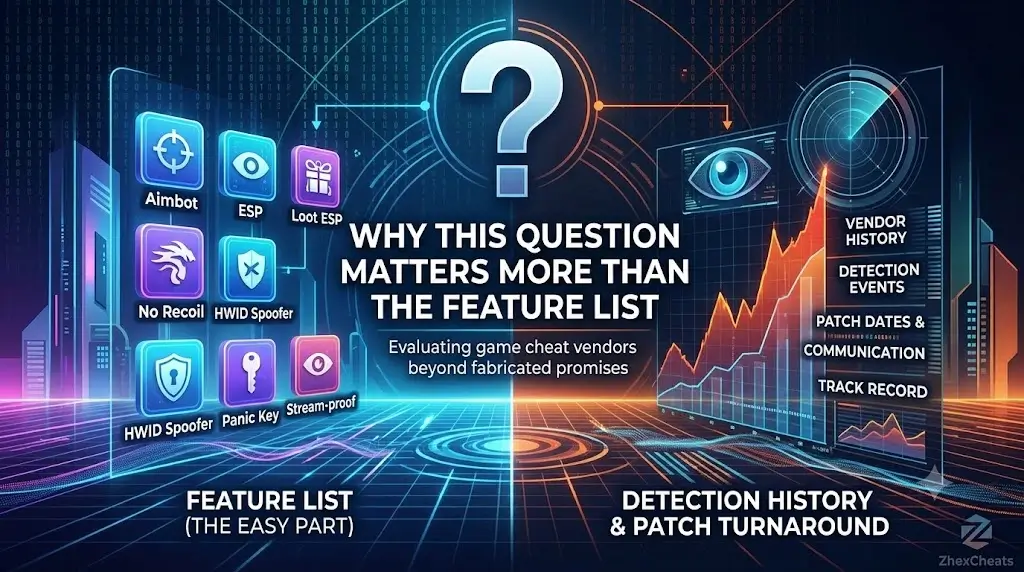
Why this question matters more than the feature list
Every cheat product page lists the same features. Aimbot, ESP, Loot ESP, No Recoil, HWID Spoofer, panic key, stream-proof. The features are the easy part. They are also the part that does not predict whether your account will survive past the second week of use.
What predicts that is something the marketing copy never centers: the vendor's actual history of detection events, how they communicated those events, and how quickly the product came back online. A working build that has never been detected is a snapshot. A vendor who has handled three detection cycles cleanly in the last year is a track record.
The cheat market knows this, which is why vendor pages are filled with reassuring numbers. Days undetected counters. Patch logs. Customer testimonials. The problem is that all three are trivial to fabricate, and the buyers most exposed to fabrication are usually the ones least equipped to spot it. ZhexCheats publishes the patch dates, detection events, and architecture for every product in the catalog precisely because the alternative, hiding any of those, has never been honest practice in this market. This article is the framework for evaluating any vendor against that same standard.
The eight signals that separate real vendors from rebranders
A legitimate cheat operation, regardless of price tier, exhibits a specific set of public behaviours. None of them individually proves the vendor is trustworthy. Together, they tell you whether you are looking at a real software shop or a reseller who buys leaked builds from elsewhere and changes the loader logo.
// VENDOR LEGITIMACY CHECKLIST, ORDERED BY DIFFICULTY TO FAKE
Patch turnaround under 4 hours, with timestamps
S-tier vendors restore service in under 2 hours. Mid-tier in under 8. Anything above 24 hours is a small operation, not necessarily bad, but priced accordingly.
Specific game version listed alongside the status
"Working on Tarkov 0.16.2.1" beats "Working on Tarkov." If the vendor cannot name the version their last build was tested against, they are not testing.
Detection events are visible in the history
A real vendor's status page shows the bad days. No detections in 18 months is not impressive; it is a sign the page is fabricated.
Public Discord with thousands of members and chat history
Empty channels with bot greetings are a tell. Real operations have customers talking about builds, patches, and complaints in actual real-time messages.
Architecture is named, not hidden
Internal? External? Kernel-mode? DMA? Capture-card? A vendor who refuses to say what category they are selling is hiding either inexperience or a rebrand.
Visible in independent community discussion
Technical forums, marketplace vouch systems, and game-specific community boards mention the vendor by name in real conversations. New shops do not appear there yet; that is fine. Established shops mentioned nowhere outside their own website are not fine.
Clear refund and ban-wave policy in writing
"Refund if detected within 7 days" is a policy. "We will work with you" is not. The policy needs a number, a trigger, and a process.
Multiple contact channels, not just Telegram DM
Website, Discord, support ticket system, and a public storefront. Vendors who only sell through private DMs are operating outside community accountability for a reason.
The order of that list matters. Items one through three are technical and time-stamped, which means they are the hardest to fake without leaving inconsistencies. Items four through eight are about visibility and accountability, which a serious shop earns over years and a fly-by-night operation cannot manufacture overnight.
How fabricated ban logs actually look
The most common form of vendor dishonesty is not outright lying about detection. It is editing the history to remove the bad parts. A product gets detected on a Tuesday. The vendor pushes an update Friday. By the following Monday, the status page reads "180 days undetected" with no acknowledgment that the counter was reset three days ago. Most buyers never check, and the ones who do are looking at a counter that has been zeroed deliberately.
The pattern is recognizable once you know what to look for. Fabricated logs cluster around round numbers, repeat the same phrasing, and time their entries to look like steady reliability rather than the irregular reality of an actual cheat lifecycle.
// FABRICATED VS AUTHENTIC BAN HISTORY, SIDE BY SIDE
FABRICATED LOG
Tells: evenly-spaced monthly updates, identical descriptions, no version-specific details, absolute claims, zero bad days.
AUTHENTIC LOG
Tells: irregular timestamps, version numbers tied to game patches, named detection events, acknowledged downtime, specific ETAs that match later updates.
The fabricated column above is constructed exactly the way bad vendors write their logs. Equal intervals, generic descriptions, and never a single line acknowledging a problem. The authentic column tells a story. Patches arrive when the game patches. Detection events show up because they always do. The vendor names the size of the affected user group and the response time. The numbers are uneven because reality is uneven.
The single most reliable signal here is the willingness to publish bad days. A vendor who has never had one is either three weeks old or lying. There is no third option in a market where Vanguard, BattlEye, EAC, and Ricochet are constantly evolving their detection capabilities.
Patch turnaround as the single hardest metric to fake
If you can only check one number, check this one. When the game updates, how long does the cheat take to come back online.
S-tier private cheat operations restore service in under 2 hours after a major game patch. This is the public benchmark used in the cheat market itself, and it is the standard that defines the upper end of pricing. Achieving it requires a development team that monitors patch announcements in real time, automated build pipelines that recompile against new game offsets within minutes, and enough engineering depth to handle whatever the patch broke without requiring a full rebuild.
Mid-tier vendors land somewhere between 4 and 12 hours. That range is normal for a small team handling updates by hand. It is also the range where most working commercial cheats operate, because hiring engineering staff capable of sub-2-hour response carries costs only the largest vendors can amortize across enough buyers.
Anything above 24 hours falls into a different category. Either the vendor is a solo operator, or the cheat is a rebrand of a build maintained by someone else and the rebrander is waiting on their upstream supplier. The price should reflect the latency. A vendor charging premium prices for 48-hour patch turnaround is selling a brand, not a product. ZhexCheats operates in the sub-4-hour tier for FPS titles, with sub-2-hour response on flagship products, because customers do not pay premium pricing to spend the weekend waiting.
Why this metric is hard to fake comes down to verifiability. Game patch announcements are public. Twitter, Steam news, official launchers all timestamp them. A vendor claiming 90-minute turnaround on a patch that landed at 14:00 should have customer chatter, Discord messages, and Twitter responses confirming the cheat was running again before 15:30. If none of that exists, the claim is decorative.
Where independent reputation actually lives
The cheat market has been around long enough to develop its own equivalents of Amazon reviews. The difference is that the legitimate review signals are never hosted on the vendor's own website.
The honest reputation lives in three places: independent technical forums where reverse engineers discuss anti-cheat behaviour, marketplace vouch systems where verified buyers leave references, and game-specific community boards where players talk about ban waves and which vendors got hit. A real vendor's name appears in all three, told by different people, with consistent stories. The names in the conversations match the names in the vouches. The vouch dates spread across months and years rather than clustering inside a single suspicious window.
Fabricated reputation looks different. It concentrates. One thread on one platform, a burst of positive reviews dated within the same week, accounts created days before they posted their first endorsement. The praise reads identically across multiple posters, which is the signature of either a coordinated promotional campaign or outright botting.
Players talking about a ban wave that affected "users of [vendor X]" without anyone defending the vendor is a useful signal. So is the inverse: vendor mentions that consistently come with positive context from accounts more than a few months old. Vendors who tell their buyers exactly where to look for community discussion, including the unflattering threads, are operating with a level of confidence that fabricators cannot match. ZhexCheats links external reputation sources directly from the product pages for that reason, because a vendor afraid of independent scrutiny is a vendor with something to hide.
Look at where the praise comes from, not just how much of it exists.
Six red flags that should end the evaluation immediately
Some signals are not subtle. When any of the following appear on a vendor's site or in their sales pitch, the evaluation is over.
// IMMEDIATE-DISQUALIFICATION SIGNALS
"100% Undetected"
No cheat is permanently undetected. Anyone claiming otherwise is not engineering, they are marketing.
"Lifetime guarantee"
Anti-cheat evolves continuously. A lifetime guarantee means the seller does not expect to be in business when it would have to honor the promise.
Telegram-only contact
No website, no Discord, no public storefront. Operating outside community visibility for a reason. Often malware-bundled.
Cryptocurrency only, no escrow
Irreversible payment, no buyer protection, no dispute path. Legitimate vendors accept crypto but also offer mediated alternatives.
Refund explicitly refused
"All sales final, no exceptions" on a product that is sometimes broken by definition. A vendor confident in their build offers ban-wave coverage.
No technical architecture mentioned
Will not say if the build is internal, external, kernel-mode, or hardware-based. Hiding the architecture usually means it is a resell of unknown origin.
The pattern across all six is the same: each one removes accountability. Absolute guarantees remove the obligation to perform. Telegram-only contact removes the obligation to maintain reputation. Crypto-only payment removes the obligation to honor refunds. A vendor stacking all six is not running a cheat business; they are running a payment-collection operation that happens to mention cheats.
One red flag is sometimes excusable. Two should stop the evaluation. Three is a definite scam.
Applying this to Tarkov, PUBG, Arena Breakout, and Valorant
The vendor-evaluation framework above applies to every game, but the weight you put on each signal shifts depending on which anti-cheat the cheat has to survive.
For Escape from Tarkov, patch turnaround matters more than almost anything else. BIG patches arrive every wipe cycle and BattlEye updates land mid-wipe; a vendor without 4-hour response capacity will spend more days offline than online. BattlEye's detection model also runs server-side telemetry that retroactively flags accounts after a vendor gets detected, which means the vendor's history of named detection events is the single best predictor of how your account will fare.
For Arena Breakout, the dual ACE plus TenProtect scanner stack means you need a vendor with explicit experience handling both layers. A cheat written for BattlEye-only games rebadged for ABI will fail within a week. Ask the vendor specifically what they do about TenProtect's user-mode introspection layer; an honest answer is detailed, a dishonest one is generic.
For Valorant, the rules are different again. Vanguard's boot-time enforcement means most kernel cheats simply do not work, and the vendors who claim they do are usually selling something the buyer cannot verify. A real Valorant vendor names the architecture explicitly, usually hardware-based or capture-card setups, and prices accordingly. A vendor offering cheap Valorant access with no architecture disclosure is selling either a scam, a rebrand of a detected build, or an old internal that will be banned before the buyer logs in.
The general principle holds across all of them. The features matter least. The architecture matters more. The track record matters most. Every product in the ZhexCheats catalog is published with all three on the page, in that order, because that is the order in which they actually predict outcomes.
Read the history before the feature list. The history is the only number that has ever predicted what happens after you click buy.
// More articles
 Game Hacking Guides
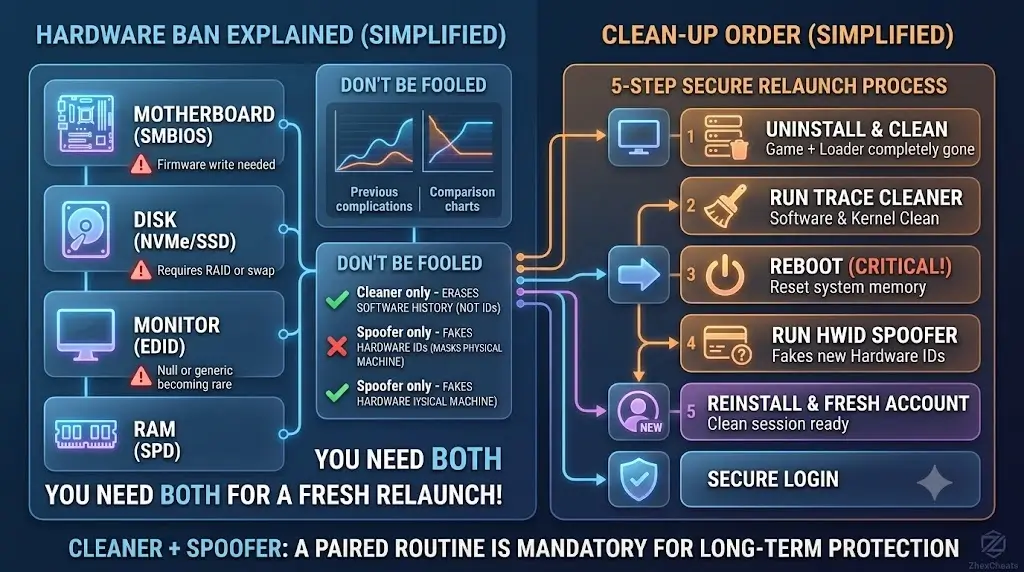
Hardware Bans Explained: Why a Software Spoofer Is Not Enough
A hardware ban fingerprints eight different components, from motherboard SMBIOS to monitor EDID. Here is what each layer actually checks and what closes the gap.
Jul 14, 2026Nathan ReedRead article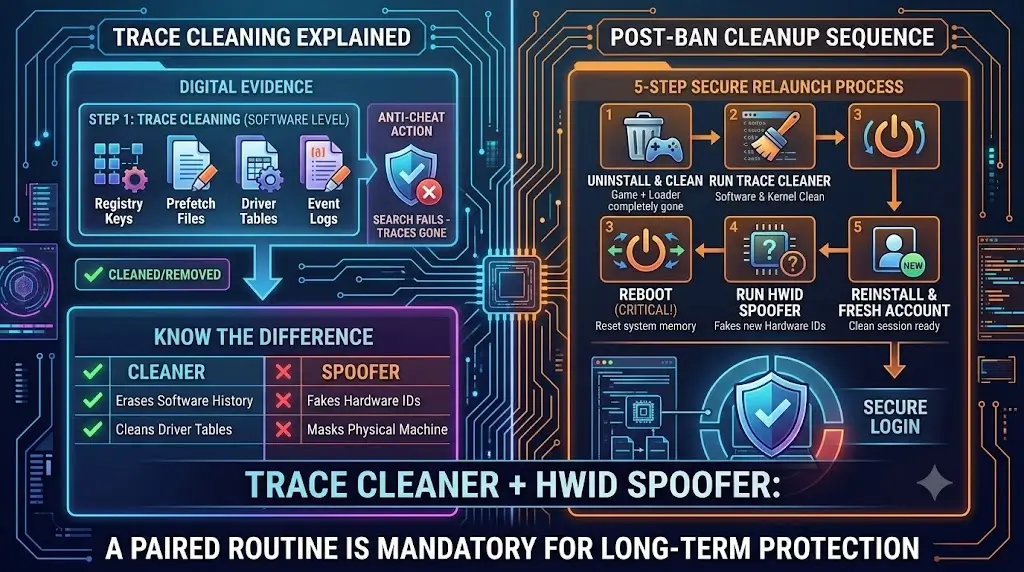 Game Hacking Guides
Trace Cleaning Explained: What Stays on Your PC After a Ban
Registry keys, prefetch files, driver load history: the records anti-cheat reads after a ban, and why a cleaner and an HWID spoofer are not the same tool.
Jul 14, 2026Nathan ReedRead article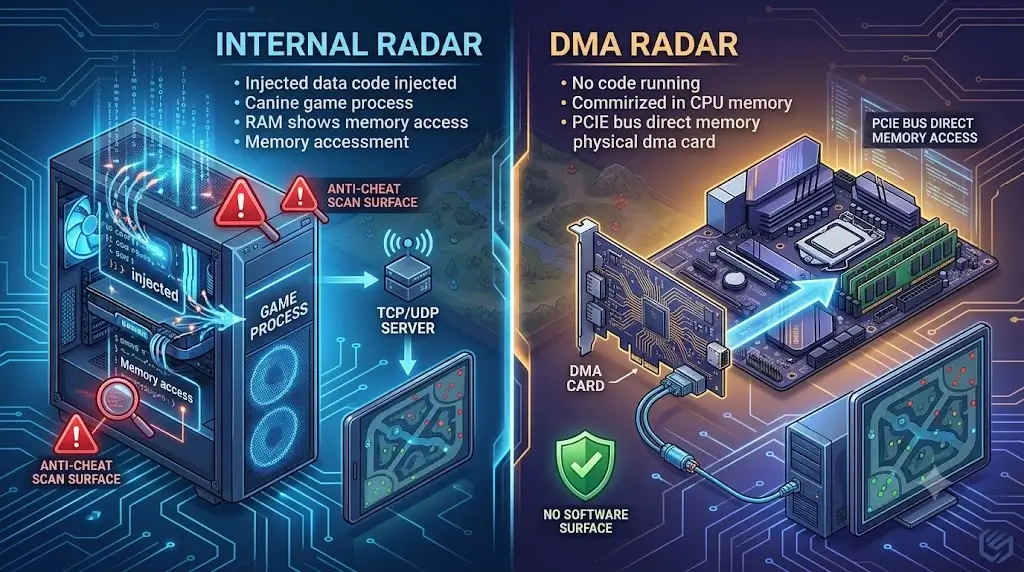 Game Hacking Guides
Radar Hack Explained: How the 2D Map Reads Every Player Position
A radar hack draws a second map that shows every player on the server in real time, without touching the game's renderer. Here is how it actually works.
Jul 12, 2026Nathan ReedRead article Game Hacking Guides
Kernel Cheats Explained: What Ring 0 Means in 2026
Ring 0 is where anti-cheat lives. A cheat that stays in user mode is fighting from outside a locked room. Here is what kernel access actually means.
May 31, 2026Nathan ReedRead article