
The glass wall: what External actually means
Every game running on your PC is a process. It owns a private slice of RAM, runs its own code inside it, and the operating system enforces hard boundaries around it. Other programs cannot reach in. That is by design.
An Internal cheat breaks that rule. It injects its own code directly into the game's memory space, usually via a DLL, and runs from the inside out. It can call the game's own functions, hook its renderer, manipulate data as if it were part of the game itself. More power. More attack surface.
An External cheat takes the opposite approach. It never enters the process. It runs as a completely separate application, like a browser or a text editor, that happens to be intensely focused on the memory of the game process next to it. It reads data from outside, calculates what it needs, and displays the result in a transparent window sitting over your screen.
That separation is the whole structural point. Everything else follows from it.
Reading game memory: how the math works
Games store their entire world state in RAM. Player coordinates, health values, item locations, team IDs: all of it lives as structured objects that the engine reads and writes thousands of times per second. An External cheat taps into that data stream using a Windows function called ReadProcessMemory.
To call it, the cheat needs four things: a handle to the game process, the exact memory address to read, a buffer to store the result, and the number of bytes to copy. The handle is the permission slip; the address is the hard part.
Games use dynamic memory allocation. Player data does not sit at the same address every time the game launches. To find it reliably, the cheat follows a chain of pointers. It starts from a static base address inside the game's module file, reads the value stored there, adds an offset like 0xA90, and follows the result to the next address. It repeats this until it reaches the actual data. Finding that chain in the first place, reversing the game's memory layout, is the real technical work behind any cheat.
Offsets are the fragile part of any External build. When a game patches, the engine recompiles and every address shifts. The cheat's offset table is now wrong. It either crashes, reads garbage from the wrong address, or behaves erratically on a live account. A provider that takes 48 hours to push offset updates is not a premium provider. Four to twelve hours is the baseline that matters.
The read loop also has a speed requirement. At 144 Hz, a frame lasts 7 ms. If the cheat's loop is slower than the monitor refresh rate, ESP boxes visibly lag behind fast-moving targets. The box appears to trail the player by half a body length. Premium builds run the read loop at or above your monitor's refresh rate. Many budget builds do not.
The overlay: drawing on top without injection
An Internal cheat draws its visuals by hooking the game's own graphics calls, injecting draw commands directly into the DirectX or OpenGL pipeline. An External cheat cannot do that because it is not inside the process. It creates a separate window instead.
The overlay is a transparent, borderless window placed exactly over the game window at the top of the Z-order. It uses two Windows extended style flags: WS_EX_TRANSPARENT and WS_EX_LAYERED. These tell the OS to pass all mouse events through to the window behind it. You click normally; the game receives every input; the overlay is invisible to the game's input handling entirely.
// What sits on your screen, top to bottom
Because the overlay never touches the game's rendering functions, integrity checks on those functions find nothing. The game's draw calls are exactly as the developer wrote them. No hooks, no patches, no injected code anywhere in the render path.
Screen capture creates a different problem. Some anti-cheat systems, Vanguard and Ricochet among them, capture the screen and compare it to what the game says it rendered. An overlay that appears in the capture but not in the game's output creates a detectable mismatch. Premium builds include Stream Proof rendering: the overlay is drawn using a method that capture APIs cannot see, while remaining fully visible on your physical monitor.
Windows handles and where the arms race starts
To call ReadProcessMemory, the cheat must first call OpenProcess and request access rights: PROCESS_VM_READ to look at memory, PROCESS_VM_WRITE to modify it. This is where modern anti-cheat systems push back hard.
Anti-cheat drivers use a kernel feature called ObRegisterCallbacks to intercept every attempt to open a handle to the game process in real time. When a suspicious process requests broad access rights, the driver strips those rights before the handle is even created. The cheat receives a handle that looks valid. Every subsequent read returns access denied.
| Privilege Level | Anti-Cheat | Games |
|---|---|---|
| Kernel on boot | Vanguard | Valorant |
| Kernel (ring-0 driver) | Easy Anti-Cheat, BattlEye, Ricochet | Fortnite, Apex, PUBG, Warzone, Tarkov |
| User mode only | VAC, Blizzard WARDEN, FairFight | CS2 (casual), older titles |
Kernel-level anti-cheats run at Ring 0, the highest privilege level on the system. They can enumerate processes, inspect memory regions, and block handle requests before any usermode application can interfere. Against a kernel anti-cheat, a standard usermode External cheat is fighting uphill from the start. The handle gets stripped. The read fails. Games like Escape from Tarkov and PUBG run BattlEye at ring-0, which is exactly why premium External builds need kernel-assisted access to remain effective.
The response from cheat developers is either to hijack handles from other trusted processes, which already have legitimate access, or to bring their own kernel-level code to match the anti-cheat's privilege level.
Kernel-assisted access: going to Ring 0
Windows organizes privilege into rings. Ring 3 is where normal applications live. Ring 0 is the kernel: the core of the OS, where hardware drivers operate and where memory access has no restrictions. Code running at Ring 0 can read any process's memory without a handle, without asking permission, without triggering ObRegisterCallbacks.
Getting code into Ring 0 on a modern Windows machine requires a signed driver. Microsoft controls that signing. Cheat developers cannot easily get their own malicious driver signed. The workaround is BYOVD: Bring Your Own Vulnerable Driver. The attacker finds a legitimate, Microsoft-signed driver from a hardware manufacturer that contains a security flaw. They load that trusted driver, exploit its vulnerability to execute arbitrary code in the kernel, and from that position call MmCopyVirtualMemory directly to read game memory.
A kernel-assisted External build reads memory at the same privilege level as the anti-cheat driver itself. The read never produces a usermode handle; it never touches ObRegisterCallbacks; it leaves no visible artifact in the handle table. From the anti-cheat's perspective, the reads look like normal kernel activity.
DMA: when software is not enough
Direct Memory Access takes the External concept to its physical limit. A dedicated PCIe board, typically an FPGA, is installed in the game PC's motherboard. That board can read the system's RAM directly over the PCIe bus, without involving the CPU, without running any software on the host. The cheat code runs on an entirely separate second machine connected via cable to the FPGA board.
On the game PC, there is nothing anomalous. No suspicious process in task manager, no unsigned driver, no memory region marked executable-but-unregistered. The anti-cheat scans the entire system and finds exactly what a clean machine looks like. The FPGA registers as normal hardware. Nothing flags.
The theoretical defense against DMA is IOMMU: the Input-Output Memory Management Unit. An IOMMU acts as a bouncer for the RAM, checking the identity of every device attempting to access memory and blocking unauthorized reads. When IOMMU is enabled and properly configured in the BIOS, a generic FPGA board cannot read arbitrary RAM regions. It only has access to what the OS explicitly mapped to it.
In practice, most consumer motherboards either ship with IOMMU disabled, configure it permissively, or the FPGA firmware is written to impersonate a whitelisted device. DMA remains the highest-tier external access method available to consumers in 2026.
| Access Method | Software on Game PC | Anti-Cheat Detects | Performance Impact |
|---|---|---|---|
| Usermode External | Cheat process + handle | Handle enumeration | Minimal |
| Kernel-assisted External | Cheat process + kernel driver | Driver scan (BYOVD) | Minimal |
| DMA / FPGA | None | IOMMU only (often misconfigured) | None on game PC |
The last problem: hiding that you are a machine
As External cheats became architecturally harder to detect through process scanning, anti-cheat systems shifted focus to what the cheat cannot hide: its output. Every action a cheat produces must eventually reach the game server as a mouse event, a camera angle, a shot registration. That data is measurable.
Anti-cheat filter drivers sit in the Windows input stack and record raw mouse and keyboard events with microsecond precision. Human aim follows Fitts' Law: movement time scales with distance and target size, deceleration curves appear near the target, micro-corrections happen within 50 to 200 ms of landing on the hitbox. A cheat that snaps the aim vector linearly in 1 ms produces a movement signature no human generates.
Singular Value Decomposition applied to mouse movement data reveals this immediately. Scripted aim movements concentrate 98.2% of their variance in a single mode. Human movements spread variance across multiple modes, averaging 73.9% in the first. The detection threshold used in research sits at 99.0%. A raw aimbot misses it by a fraction; a well-humanized one clears it.
Premium builds implement humanization algorithms that replicate human motor noise. Deceleration near the target, slight overshoot followed by correction, micro-jitter modeled on hand tremor, variable reaction delay between 50 and 120 ms. The goal is a movement distribution that falls within the human histogram, not just below the threshold but indistinguishable from a legitimate good player.
This is the final layer of the arms race. The cheat is no longer fighting to hide its code. It is fighting to hide that it is a machine at all. Humanization quality is one of the sharpest differences between providers — it is the main reason Apex Legends cheats from a premium build survive longer than any free alternative running identical memory access techniques.
What premium actually looks like
Most product pages describe features. ESP, Aimbot, Radar, No Recoil: every provider lists the same things. The differences that matter are in the infrastructure, not the feature names.
// What separates premium builds from budget ones
Patch speed is where most cheap providers fail visibly. A game update drops at 2 AM. Offsets shift. Every user's build crashes or reads garbage. A quality provider has a working update within hours. A slow one leaves users running a broken build through the next day's play session, which produces erratic in-game behavior on a live account. Erratic behavior draws reports. Reports draw manual review.
The HWID Spoofer matters the moment a ban lands. Hardware bans attach to machine identifiers: disk serial numbers, MAC addresses, motherboard IDs. A fresh account on the same machine inherits the ban within minutes of first login. A Spoofer rotates those identifiers before login. Clean history. The ban does not follow the hardware.
ZhexCheats External cheats ship with kernel-assisted access, Stream Proof overlay, Panic Key, HWID Spoofer bundled, and patch coverage within hours of every game update. Builds are private, seat-limited, and maintained by teams tracking anti-cheat update cycles in real time. See available titles: Tarkov, PUBG, Apex Legends, and 20+ more.
// More articles
 Game Hacking Guides
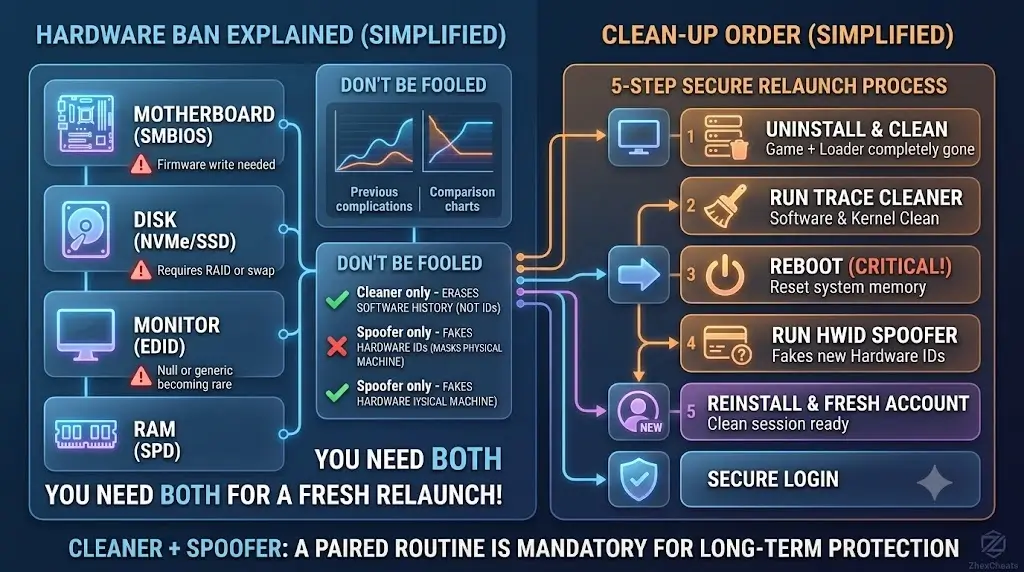
Hardware Bans Explained: Why a Software Spoofer Is Not Enough
A hardware ban fingerprints eight different components, from motherboard SMBIOS to monitor EDID. Here is what each layer actually checks and what closes the gap.
Jul 14, 2026Nathan ReedRead article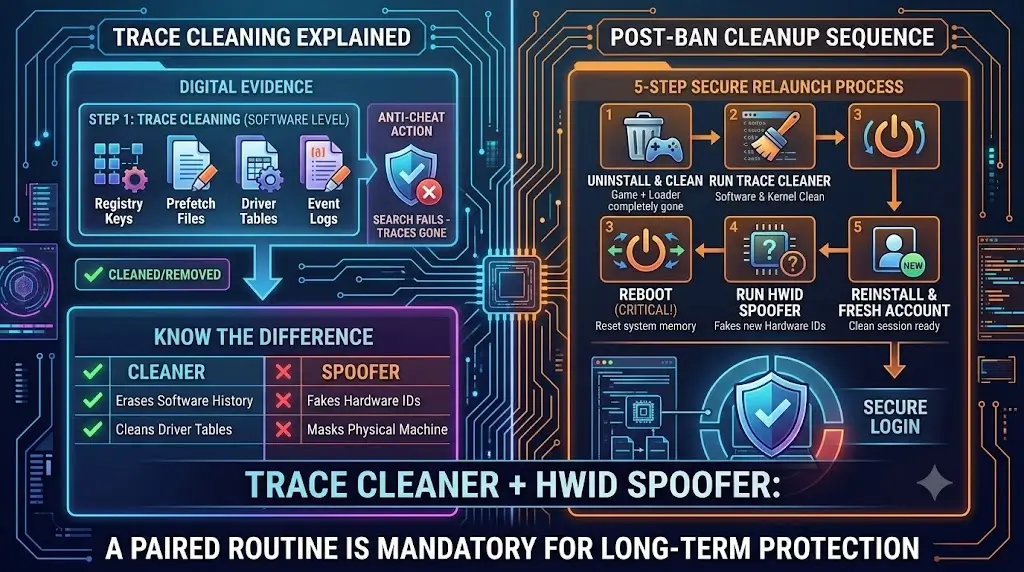 Game Hacking Guides
Trace Cleaning Explained: What Stays on Your PC After a Ban
Registry keys, prefetch files, driver load history: the records anti-cheat reads after a ban, and why a cleaner and an HWID spoofer are not the same tool.
Jul 14, 2026Nathan ReedRead article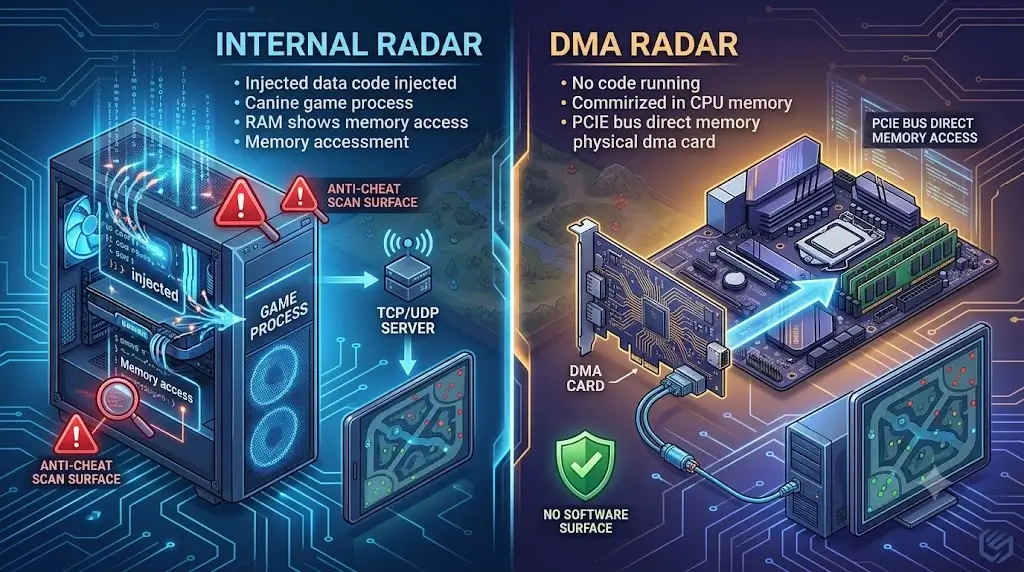 Game Hacking Guides
Radar Hack Explained: How the 2D Map Reads Every Player Position
A radar hack draws a second map that shows every player on the server in real time, without touching the game's renderer. Here is how it actually works.
Jul 12, 2026Nathan ReedRead article Game Hacking Guides
How to Read a Cheat Vendor's Ban History (And Spot Fake Logs)
Days-undetected counters, patch logs and testimonials are trivial to fake. The eight signals that separate real vendors from rebranders.
Jul 11, 2026Nathan ReedRead article