Why hardware fingerprinting is no longer enough
Your handwriting is yours. A forger can copy the letters, reproduce the slant, match the ink weight, but the timing of each stroke, the millisecond hesitations before a curve, the micro-tremors that happen below the threshold of conscious control: those are not in the visible output. They are in the motor pattern. You cannot copy what you cannot see.
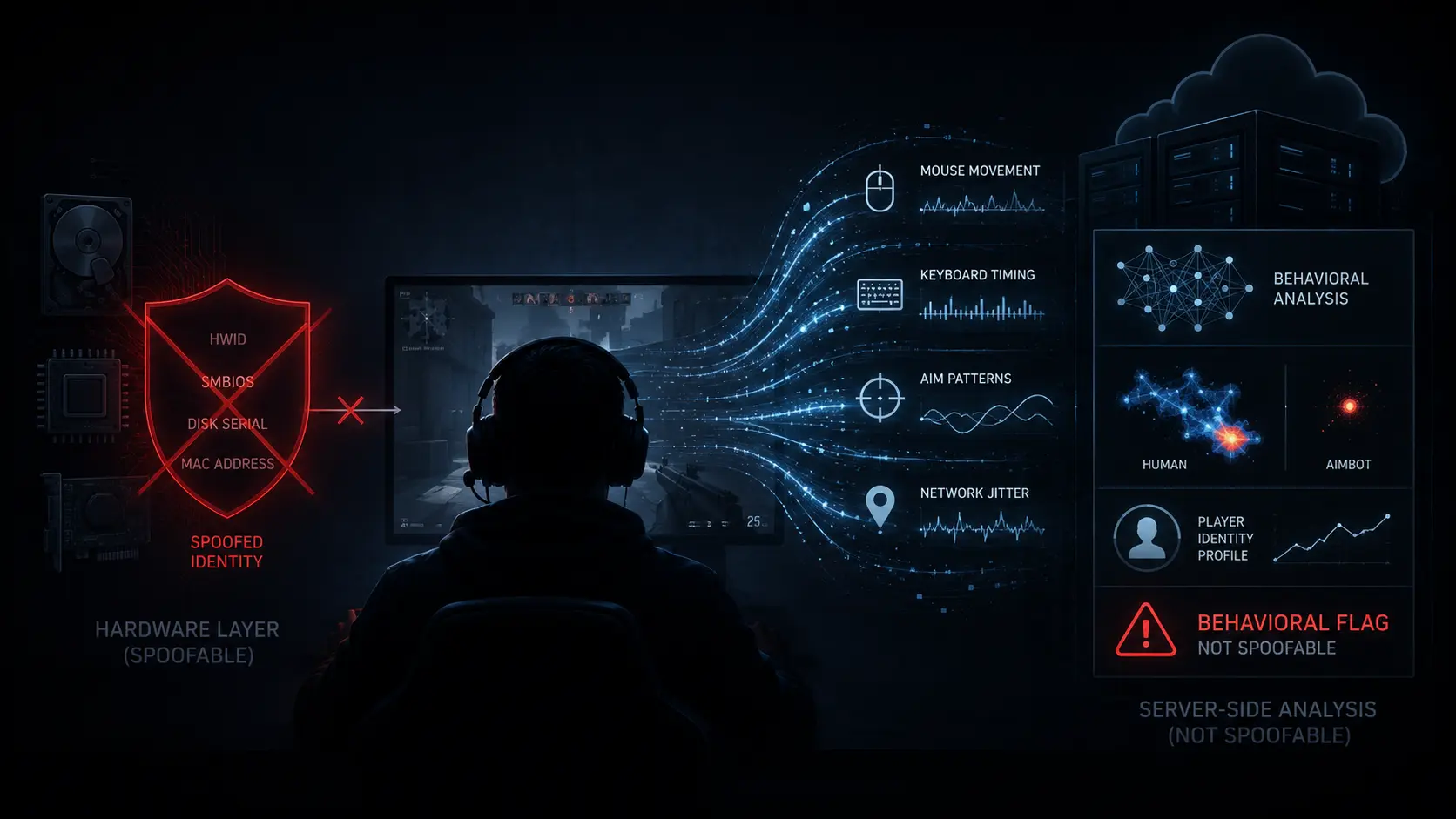
Anti-cheat systems have reached the same conclusion about gaming input. Changing a disk serial number defeats a hardware ban. It does not change how your wrist moves when you track a target through smoke. A HWID Spoofer produces a clean fingerprint at the hardware query layer; it produces nothing at the behavioral layer, because behavior is not queried. It is observed.
This shift is not theoretical. It is documented, deployed, and producing bans in live games right now. The research behind it is public, the accuracy numbers are uncomfortable, and the mechanism has no known software countermeasure.
What behavioral biometrics actually measures
The raw data is simple: X and Y mouse coordinates with timestamps, sampled at 500Hz or higher. What the analysis extracts from that stream is not simple at all.
At the micro level, each aim movement carries 33 distinct statistical features: acceleration derivatives, path curvature, the ratio of net displacement to total path length (called straightness ratio), velocity peaks and their timing relative to the target crossing the crosshair. A flick shot has a different signature than a tracking movement, and a human tracking movement has a different signature than an Aimbot tracking movement even when the endpoint is identical. The difference is in the approach curve, the micro-corrections at the end of the motion, and the deceleration profile before the shot fires.
// Aim path density: human vs aimbot (500Hz sample, 200ms window)
HUMAN — irregular, curved approach
spread: natural, off-center density
AIMBOT — linear lock, single-pixel precision
spread: two-pixel cluster, no approach variance
darker = higher sample density. human aim distributes; aimbot collapses to a point.
At the macro level, a 60-second observation window captures crosshair placement habits: where you park the aim between engagements, how close to head height you idle in common angles, the rhythm of your pre-aim before pushing a corner. These patterns are not in the individual shot. They are in the session. An Aimbot trained to soften individual flicks still cannot replicate the pre-aim behavior of the specific human it replaced.
Keyboard timing adds a second independent channel. The duration of each keypress, called dwell time, and the gap between releasing one key and pressing the next, called inter-key interval, vary in ways that are specific to the individual. A player who taps WASD lightly in 60ms bursts produces a different signal than one who presses firmly for 180ms. These patterns are stable across sessions and not consciously controllable.
The BEACON dataset: 430 GB of how you play
BEACON is the most comprehensive published study of behavioral biometrics in gaming. The dataset was built on Valorant sessions and contains 102 hours of active gameplay from 28 players across 79 sessions. That is 430 GB of synchronized data: 90 million mouse events, 500,000 keystrokes, 114 million network packets, and screen recordings time-aligned to all of it.
The research goal was to answer a specific question: can a system trained on your mouse and keyboard data recognize you accurately enough to flag when someone else is playing your account? The answer came back yes, with accuracy numbers that make the question worth taking seriously.
How accurate the detection gets
The accuracy numbers from BEACON and related research depend on what data channels are combined and how long the observation window runs. Single-channel analysis on mouse data alone reaches 50% accuracy for player identification. That sounds weak until you understand the context: 28 players, random chance is 3.6%, and that is with mouse data only.
// Detection accuracy by data channel combination (BEACON, 2025)
Mouse only
Var-CNN model
Mouse + Keyboard
Early fusion
Mouse + KB + Network
Full fusion
EER (error rate) drops to 4.31% on full-channel fusion. Random baseline for 28 players: 3.6%.
The CS2-specific research produces sharper numbers for the narrower detection task: not "is this the same player" but "is this player using an Aimbot." On that binary question, CNN models trained on mouse streams reach 98.9% Aimbot detection accuracy and 99.2% Triggerbot detection accuracy. Those numbers reflect a fundamentally different structure of motion: Aimbot movements collapse to a two-pixel cluster on the heatmap, human movements spread across a region with irregular density. The difference is not subtle.
Which games already use behavioral analysis
| Game / System | Behavioral method | Status |
|---|---|---|
| Valorant (Vanguard) | Mouse + keyboard stream analysis, BEACON research base, Vanguard kernel data collection | Active, kernel-level collection |
| CS2 (Valve) | VACnet: neural net trained on mouse and movement data, server-side analysis | Active, server-side |
| Call of Duty (Ricochet) | "Mitigation" layer: weapon removal on live suspects while data is collected; Splunk telemetry pipeline | Active, real-time mitigation |
| Battlefield V, Titanfall 2 (FairFight) | Server-side statistical outlier detection on telemetry events | Active, server-side only |
| Escape from Tarkov (BattlEye) | Behavioral flags feed manual review queue; no confirmed automated model | Partial, feeds manual review |
Ricochet's mitigation approach is worth noting separately. When the system flags a suspect, it does not immediately ban. It removes the player's weapons or makes enemies invisible to them while continuing to collect data. The suspect keeps playing, unaware, and every additional input event strengthens the behavioral record before the ban wave. The data collection window is effectively as long as the suspect's next session.
Why a HWID Spoofer cannot fix a behavioral flag
A HWID Spoofer intercepts hardware identifier queries and substitutes clean values. It operates at the driver level, between the anti-cheat and the storage or firmware layer. That interception has no surface area that touches input events. Mouse coordinates are reported by the HID driver stack; they carry no hardware serial, no SMBIOS value, nothing a spoofer touches. A behavioral flag and a hardware ban are different records in different databases, and clearing one has no effect on the other.
The deeper problem is that behavioral data is collected server-side. The game client sends input telemetry to Valve, Riot, or Activision servers where the analysis runs. A kernel driver on your machine cannot intercept a network packet after it leaves your NIC. The behavioral record exists on their infrastructure, not yours.
That gap is real. It is also why understanding the full anti-cheat picture matters more now than it did when hardware bans were the primary enforcement mechanism. If you want to understand how the hardware layer works and what a kernel-level spoofer actually covers, the HWID Spoofer Explained article covers that in detail. For the TPM and remote attestation side of hardware enforcement, see TPM and Remote Attestation Explained.
Where this is heading
The research direction is toward shorter observation windows and higher accuracy on less data. Current models need 60 seconds to reach reliable identification. Papers published in 2025 describe architectures that reach comparable accuracy in under 10 seconds on mouse data alone, using transformer models trained on the sequential structure of aim movements rather than aggregate statistics.
Network jitter as a secondary channel is likely to see more investment because it requires no client-side instrumentation and cannot be modified by anything running on the game machine. Your routing path is a property of your physical location and ISP. It is stable, unique at the session level, and completely outside the control surface of any software running locally.
The implication is direct: the countermeasure arms race has moved off the hardware layer. Changing a disk serial is still relevant for hardware bans on titles that enforce them. It stops being relevant the moment the enforcement mechanism shifts to a server-side model that never queried your disk serial in the first place.
// 更多文章
 Game Hacking Guides
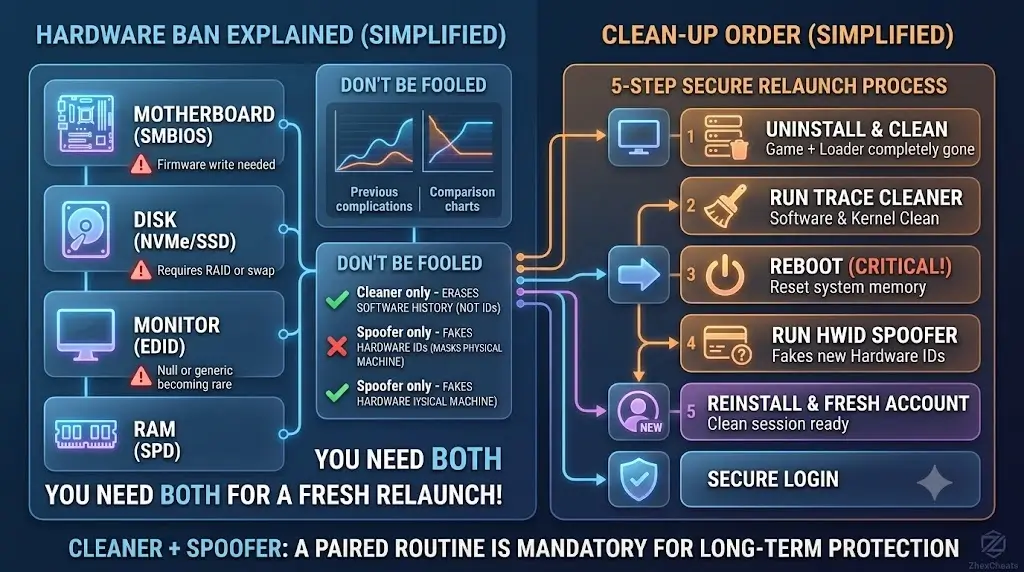
Hardware Bans Explained: Why a Software Spoofer Is Not Enough
A hardware ban fingerprints eight different components, from motherboard SMBIOS to monitor EDID. Here is what each layer actually checks and what closes the gap.
Jul 14, 2026Nathan Reed阅读文章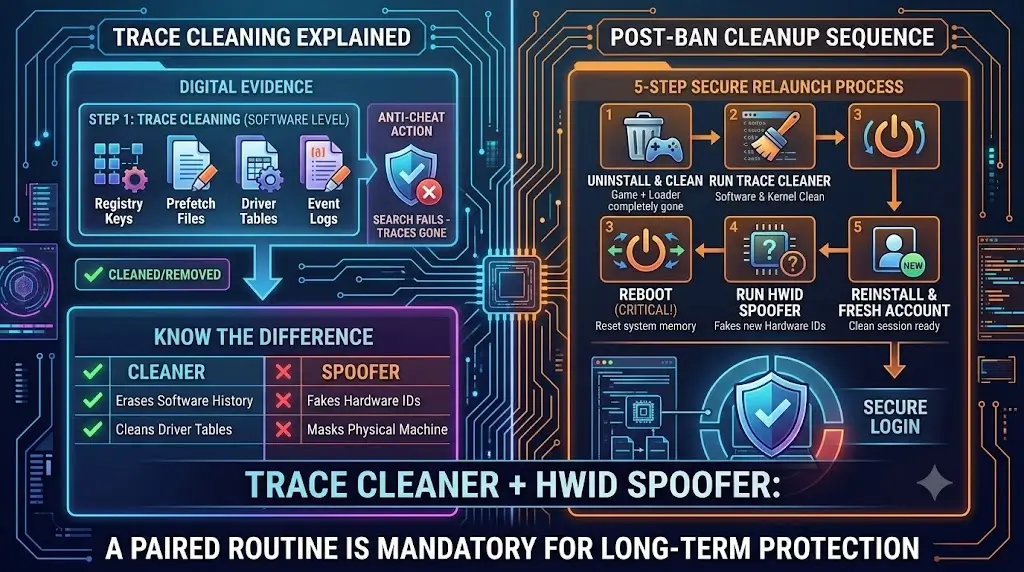 Game Hacking Guides
Trace Cleaning Explained: What Stays on Your PC After a Ban
Registry keys, prefetch files, driver load history: the records anti-cheat reads after a ban, and why a cleaner and an HWID spoofer are not the same tool.
Jul 14, 2026Nathan Reed阅读文章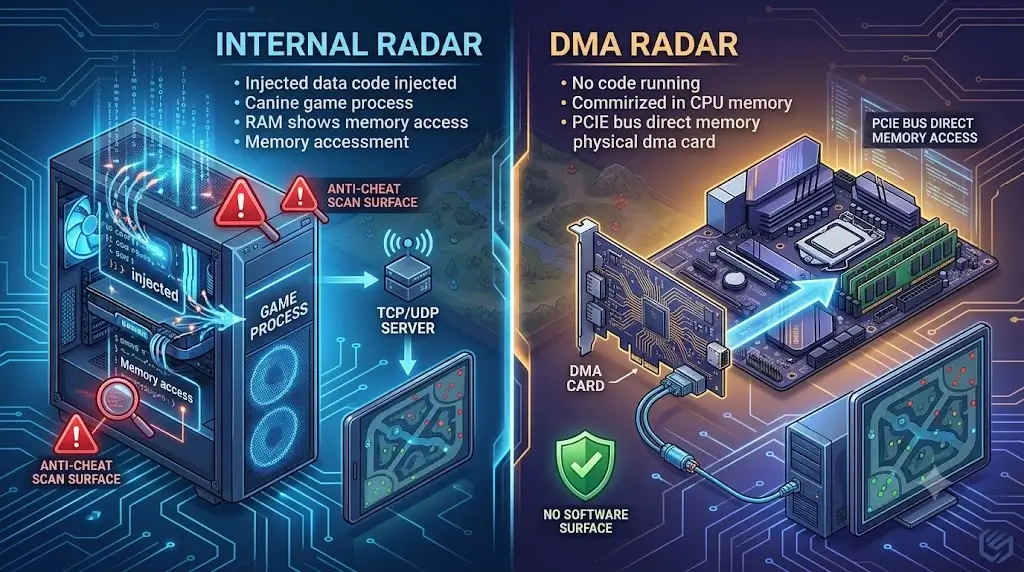 Game Hacking Guides
Radar Hack Explained: How the 2D Map Reads Every Player Position
A radar hack draws a second map that shows every player on the server in real time, without touching the game's renderer. Here is how it actually works.
Jul 12, 2026Nathan Reed阅读文章 Game Hacking Guides
How to Read a Cheat Vendor's Ban History (And Spot Fake Logs)
Days-undetected counters, patch logs and testimonials are trivial to fake. The eight signals that separate real vendors from rebranders.
Jul 11, 2026Nathan Reed阅读文章