What buyers actually want when they ask "is it undetected"
The question is never really about the word. When someone asks whether a cheat is undetected, they are asking something smaller and far more personal: will my account survive the night, and will the hardware I paid for still load the game next week. That is the fear underneath the question. Everything else is detail.
So every storefront in this market answers with the same two words. "100% undetected." It is printed on landing pages, stamped on product cards, repeated in Discord pins. The phrase has been used so often that it has stopped carrying information. A buyer reads it and feels nothing, because the scammer selling a flagged build last week used the exact same sentence.
This article is the long answer the phrase refuses to give. By the end you will know what undetected can and cannot mean in 2026, why a cheat that was safe on Monday gets your account banned on Thursday with no change on your side, and the specific questions that separate a maintained provider from a marketing page.
Three things "undetected" does not mean
Start by clearing the ground. Most of the disappointment in this hobby comes from a buyer and a seller using the same word to mean three different things. Here is what the word does not promise, no matter who prints it.
It does not mean the anti-cheat cannot see the cheat. Vanguard, EAC, and BattlEye run at the kernel level, Ring 0, with more authority over your machine than the game itself. Vanguard loads at boot, before Windows finishes starting. A claim that any software is permanently invisible to a system with that level of control is not a technical statement. It is a slogan.
It does not mean a ban is impossible. It means a ban has not happened yet for this build, on this detection cycle. Those are not the same sentence, and the gap between them is where accounts are lost.
It does not mean detection equals an instant ban. Detection and enforcement are separated on purpose. An anti-cheat can flag your client at 9 PM and let you keep playing for six more days while it quietly builds a case. The silence is not safety. It is the design.
What undetected actually is: a maintenance state
Here is the version that holds up. Undetected is not a property baked into a file at compile time; it is a condition that has to be actively defended, every patch, against a system that is also updating. It is a maintenance state, not a feature.
Two mechanisms keep a serious build in that state. The first is signature rotation. Anti-cheats scan memory for known byte patterns, fixed fingerprints left by a specific build. A good provider answers with polymorphic loading: the cheat carries a different digital signature every time it injects, so the static scan has no constant pattern to match. The shape keeps moving. The scanner keeps missing.
The second is the harder one, and the reason a HWID Spoofer alone cannot save you. Modern systems no longer only read the file; they watch the hand. Behavioral telemetry measures the statistical character of your mouse movement, and a perfect machine correction looks nothing like a human wrist. The full mechanism, including why no spoofer touches it, is its own subject in the behavioral biometrics explained guide. The short version: undetected in 2026 means defeating a pattern scan and passing a behavior check at the same time, on every update.
That distinction matters more than the feature list.
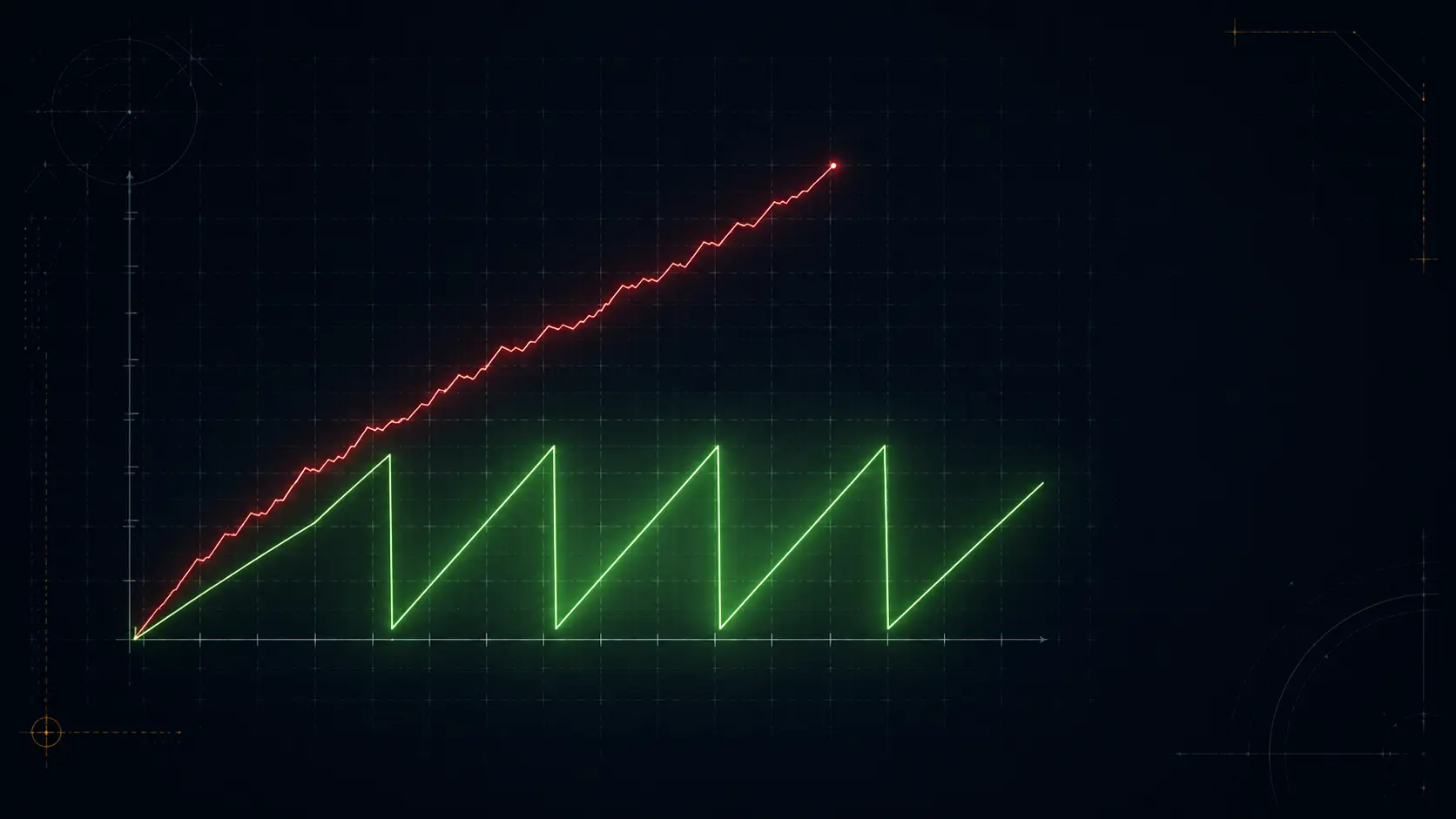
Detection risk over time, since last build release
Public risk climbs and stays high once the binary reaches a forum. Private risk creeps up between patches, then resets each time the provider rebuilds the signature.
The decay curve: why public and private age differently
A public cheat and a private cheat can ship the identical feature on day one. They do not age the same way, and the reason is not code quality. It is distribution.
The moment a build is posted somewhere open, a cracking forum, a free Discord, a marketplace anyone can join, it stops being yours alone. Anti-cheat staff sit on those same forums. They download the file like any other user, reverse it, and add its fingerprint to the scan list. Often within hours. The cheat is now a detection target before most buyers have even run it.
A private build avoids the crowd. It is sold to a limited number of subscribers, and a good one is compiled per subscriber, so no two users share the exact same executable. Combined with quiet loading methods that skip the obvious Windows APIs, the file stays "unknown code" to a kernel scan for longer. Not forever. Longer.
The decay curve above is the shape of this. Public risk climbs fast and stays pinned high, because the signature is already catalogued and nothing the user does pulls it back down. Private risk drifts upward slowly between patches, then drops each time the provider rebuilds and rotates the signature ahead of the next scan definition. Undetected lives in those resets. Skip a reset and the curve just keeps climbing.
The detection lifecycle: how a ban wave is built
This is the part that catches honest people off guard. You ran the cheat all weekend. Nothing happened. You concluded it was safe. On Thursday, the ban arrives, and it arrives at the same hour for thousands of other accounts. That timing is not bad luck. It is a ban wave, and it runs on a fixed loop.
Anti-cheats almost never ban at the moment of detection. An instant ban tells the cheat developer exactly which feature tripped the alarm, so they patch it in an hour and the cycle resets. Delaying the ban hides the trigger and lets the system punish a whole batch of accounts at once, which does far more damage to a provider's reputation. The delay is a weapon, not a mercy.
You feel safe through stages 1 to 3. The account only goes dark at stage 4, often a week or more after the original flag.
The loop has four stages. A flag, when a memory scan or behavior check marks your client. A batch, where flagged accounts are collected server side and cross checked against telemetry. A review window that confirms the pattern. Then the wave, where the whole batch is banned in one stroke. On systems like FACEIT's anti-cheat the gap from flag to wave has run about a week. PUBG's BattlEye batches its enforcement the same way, which is exactly why a build can feel clean for days and still be walking you toward a ban. The mechanics of that BattlEye loop are broken down in the PUBG BattlEye detection guide.
Read the silence correctly. No ban yet is not the same as no flag yet.
How to verify a provider's undetected claim
So the word is unreliable and the danger is delayed. What can a buyer actually check before paying? More than you would think. A provider that is genuinely maintaining a build leaves evidence; a provider that is selling a slogan cannot fake all of it. Here is the checklist that separates the two.
Run any storefront down the left column. The single most useful question to ask, the one a slogan cannot answer, is this: what is your average patch response time after an anti-cheat update, and where can I watch your live status. A maintained provider has a number and a page. A reseller flipping a shared build has neither.
This is the standard ZhexCheats is built around. Status moves per title on the Escape from Tarkov page and the Arena Breakout page the moment a build goes into maintenance, and a HWID Spoofer is part of the safety layer rather than an upsell. When BattlEye or EAC ships a definition update, the build is rebuilt and pushed before the next ranked reset, which is the only thing that actually keeps the decay curve resetting instead of climbing.
The honest version of the answer
So, is it undetected. The honest answer is the one no marketing page will print: yes, right now, for this build, on this detection cycle, and staying that way is a job that never finishes. That sounds weaker than "100% undetected." It is the opposite of weaker. It is the only version that survives contact with a Ring 0 anti-cheat.
Anti-cheat capability is not a secret and it is not shrinking. Vanguard, EAC, and BattlEye will keep shipping new memory scans and driver blocklists, and any provider claiming permanent immunity is either lying or does not understand their own product. Average uptime on the hardest targets is a moving number, not a guarantee; on heavily defended titles like Valorant it has historically hovered around half, which is precisely why provider response speed matters more than any badge.
What you are buying, when you buy from someone serious, is not a promise that the curve never rises. It is the team that resets it. If you want to see that maintenance in practice, watch the live status indicators and patch notes on the PUBG page and the Valorant page across a few update cycles. The status that keeps moving is the one telling you the truth.
// Mais artigos
 Game Hacking Guides
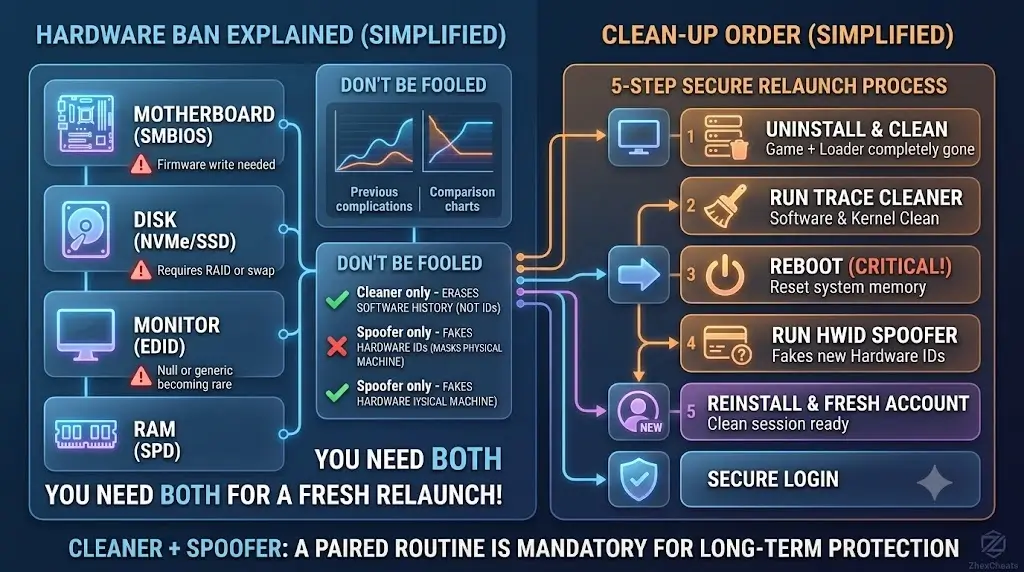
Hardware Bans Explained: Why a Software Spoofer Is Not Enough
A hardware ban fingerprints eight different components, from motherboard SMBIOS to monitor EDID. Here is what each layer actually checks and what closes the gap.
Jul 14, 2026Nathan ReedLer artigo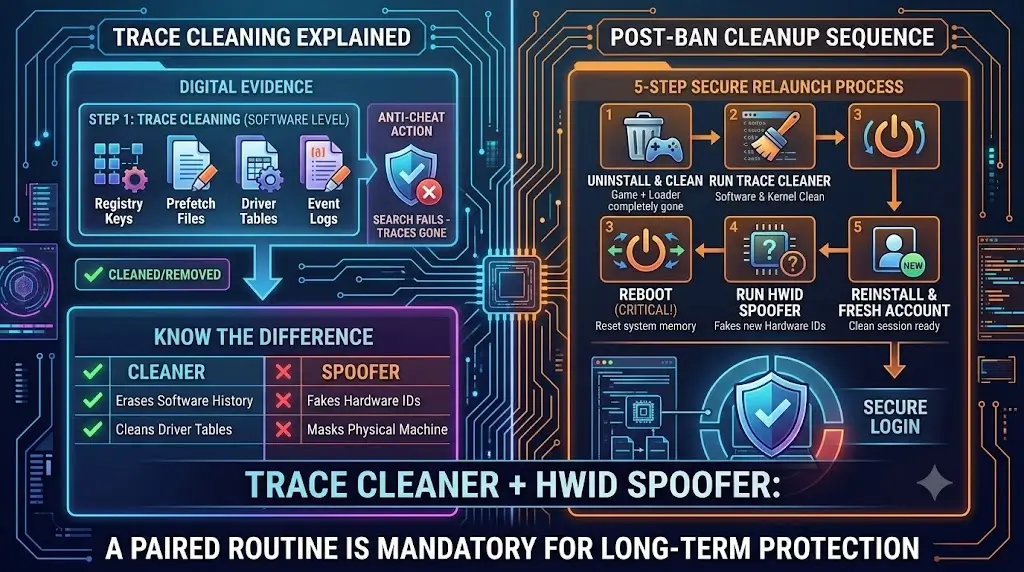 Game Hacking Guides
Trace Cleaning Explained: What Stays on Your PC After a Ban
Registry keys, prefetch files, driver load history: the records anti-cheat reads after a ban, and why a cleaner and an HWID spoofer are not the same tool.
Jul 14, 2026Nathan ReedLer artigo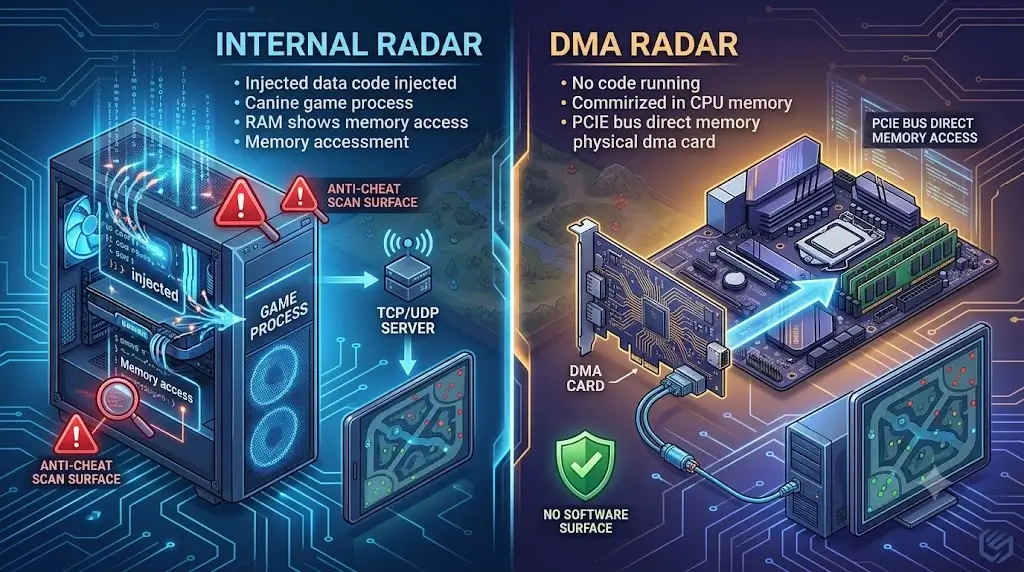 Game Hacking Guides
Radar Hack Explained: How the 2D Map Reads Every Player Position
A radar hack draws a second map that shows every player on the server in real time, without touching the game's renderer. Here is how it actually works.
Jul 12, 2026Nathan ReedLer artigo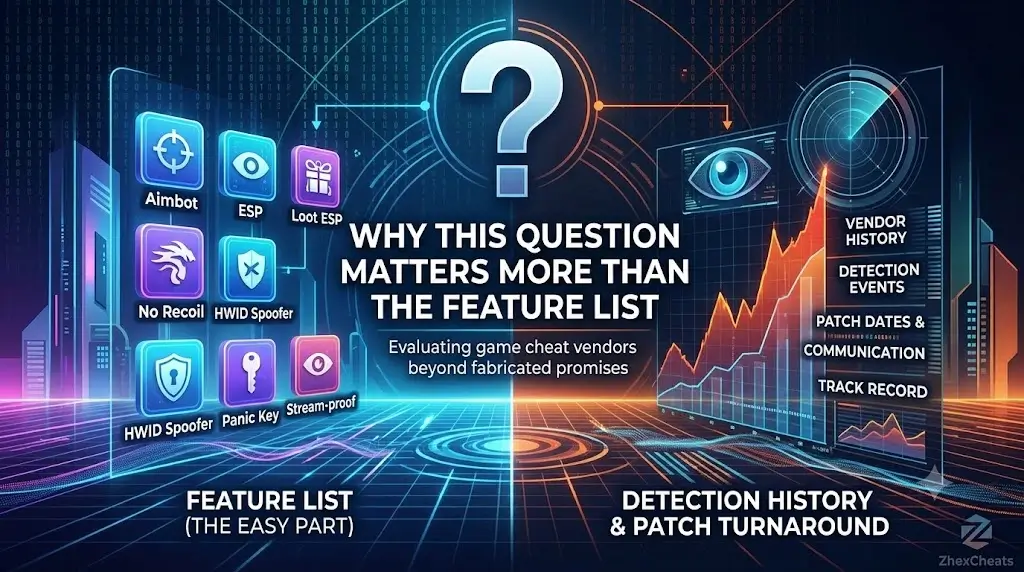 Game Hacking Guides
How to Read a Cheat Vendor's Ban History (And Spot Fake Logs)
Days-undetected counters, patch logs and testimonials are trivial to fake. The eight signals that separate real vendors from rebranders.
Jul 11, 2026Nathan ReedLer artigo