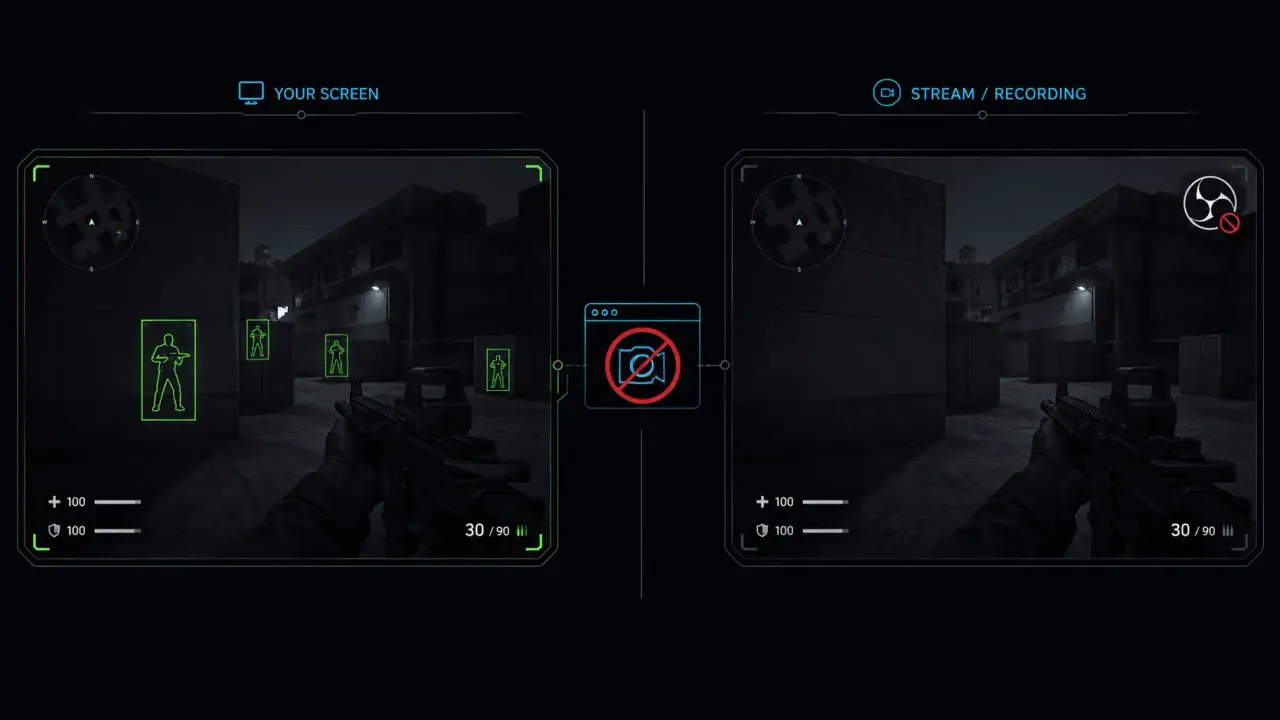
What streamproof actually means
You clip a clean play, post it to your friends, and a week later your account is gone. You scrub back through the clip frame by frame and there it is in the upper corner: a box that has no business being there. The anti-cheat never touched you. A human reported you off a video you uploaded yourself.
Streamproof is the property that stops exactly that situation. A properly built streamproof overlay draws boxes, skeleton outlines, and radar data on your physical monitor while every recording application that runs on your machine captures nothing but raw game footage. Same screen. Two entirely different images: one landing on your eyes, one going to the file or the stream.
The word gets used loosely. A lot of providers claim it and mean "beats OBS Game Capture in one specific mode." That narrow definition is where accounts get lost. What streamproof actually requires is surviving every capture path Windows exposes, not just the obvious one.
Game Capture vs Display Capture
The first thing to understand is that recording software does not have one way of seeing your screen. It has two modes that work on completely different principles, and a build that defeats one of them while failing the other is not streamproof.
OBS Game Capture injects a hook into the game process itself and grabs frames directly from the GPU buffer the game writes to. It sees exactly what the game renders, nothing more. If a cheat draws into that same buffer, Game Capture reads those pixels as part of the game and they show up in the recording. OBS Display Capture, Discord stream, and Xbox Game Bar do the opposite: they do not care about the game process at all. They ask Windows for the finished composited desktop image, the same frame that would go to the monitor, and record that instead. Beating one mode while failing the other puts the overlay in the clip.
Nvidia Shadowplay (GeForce Experience) and AMD ReLive complicate this further. These tools use GPU-level capture APIs, NVFBC for Nvidia hardware and AMFBC for AMD, which bypass the Windows compositor entirely and read directly from the framebuffer on the graphics card. Standard window exclusion flags do not always reach that layer. A streamproof build that relies only on Windows API tricks may still be visible in a Shadowplay recording, which is why architecture matters more than a single flag.
The capture APIs that matter
Underneath Game Capture and Display Capture are the actual Windows interfaces that software uses to pull pixels off the screen. Each one behaves differently, and a streamproof build is designed around what each can and cannot see.
| API | What it reads | Respects exclusion flags |
|---|---|---|
| GDI BitBlt, PrintWindow | Per-window pixel copy from a software buffer. Old path used by simple recorders and anti-cheat screenshot functions | Partial |
| DXGI Desktop Duplication | Full desktop frame from GPU memory. Backbone of high performance Display Capture in OBS and similar tools | Yes, with correct flag |
| Windows Graphics Capture (WGC) | Modern Windows 10 and 11 per-window or per-monitor capture used by Discord, Xbox Game Bar, modern OBS | Yes, WDA_EXCLUDEFROMCAPTURE |
| NVFBC, AMFBC | GPU-level framebuffer read by Nvidia and AMD recording tools, bypasses Windows compositor | No, requires DMA or kernel layer |
The flag column is what determines whether a software streamproof method holds up. Windows Graphics Capture and DXGI respect SetWindowDisplayAffinity when set to WDA_EXCLUDEFROMCAPTURE. The GPU-level paths used by Shadowplay and ReLive do not. Medal.tv and Outplayed use WGC and DXGI in most configurations, so a correctly flagged external window beats them alongside OBS. Shadowplay is a separate problem that requires a different layer of isolation.
Why internal cheats bleed to stream
An internal cheat injects a DLL into the game process and hooks the graphics pipeline directly, intercepting calls like the DirectX Present function or glDrawElements. It draws from inside the game's own render loop, which gives it pixel-perfect positioning and fast refresh. It is also the reason internal builds appear in recordings. This is the core structural reason why CS2 and Valorant premium builds default to external architecture.
The cheat's visuals are written into the game's swap chain before the frame leaves the render pipeline. When OBS Game Capture grabs that buffer, the overlay pixels are already baked in. The recording software has no way to separate them from the game image because they were added at the same stage the game adds its own graphics. They are not on top of the frame. They are inside it.
How external overlays disappear from recordings
An external cheat runs as its own process completely outside the game. It reads memory from outside, does its own world-to-screen math, and draws into a transparent top-most window that floats above the game viewport. Nothing it does touches the game's rendering pipeline. The game's draw calls are untouched and every integrity check on those functions finds nothing.
The mechanism that removes the overlay from capture is a single Windows API call: SetWindowDisplayAffinity with the value WDA_EXCLUDEFROMCAPTURE. When this flag is applied to the overlay window, the Desktop Window Manager includes that window in the signal it sends to the physical monitor but strips it from the frame it hands to WGC and DXGI. The monitor shows the overlay. Every recording application gets a transparent gap where it was. The window also carries WS_EX_LAYERED and WS_EX_TRANSPARENT style bits so mouse input passes through to the game without interference.
This is why external architecture is the standard for premium builds. Streamproofing is a property of the architecture, not a feature bolted on afterward. An external window with the correct flag set is invisible to every WGC and DXGI consumer by design, not by workaround.
Streamproof vs anti-screenshot: not the same thing
These two features solve different problems and are often confused. Understanding the difference matters because some providers advertise one while the other is what you actually need.
BitBlt and PrintWindow in most cases, and returning a clean frame to the anti-cheat while the real overlay stays visible to the player.
A build can be streamproof without being anti-screenshot, and anti-screenshot without being streamproof. The strongest setups cover both independently. Streamproof closes the video evidence path; anti-screenshot closes the automated server-side scan path. Losing one while having the other still leaves a gap that costs accounts.
DMA hardware: capture cannot reach it
Software streamproofing depends on Windows honoring flags. Hardware capture paths like NVFBC can bypass those flags entirely. DMA removes the question by taking the cheat off the game machine completely.
A DMA setup routes a Xilinx-based FPGA card through a PCIe slot on the game machine and runs the actual cheat software on a second computer. The card reads RAM over the bus. On the game PC there is no cheat process, no cheat window, no cheat driver, nothing for OBS, Shadowplay, or an anti-cheat scanner to find. The overlay is composited into the video signal through a hardware fuser before it reaches the monitor, at the cable level, never touching Windows at all. For high-stakes titles like Tarkov where BSG runs manual account reviews, DMA is the only method that closes every software detection path simultaneously.
Because the cheat image never exists as software on the game machine, NVFBC cannot capture it, WGC cannot capture it, and even a game PC screenshot taken by anti-cheat shows only clean footage. The only remaining risk is a phone pointed at the monitor from outside, and even that risk is reduced significantly because the overlay stays off the physical display when the hardware fuser detects no active game session.
Where non-streamproof builds actually fail
The ways a visible overlay finds its way into evidence are not equal. Some are common. Some get careful players who think they are safe.
The Shadowplay row catches players who run a complete external streamproof build and still get caught because they forgot Nvidia's background recorder was active. NVFBC operates below the layer that WDA_EXCLUDEFROMCAPTURE reaches. Disabling Shadowplay manually or using a DMA layer that puts the image outside the game machine entirely are the only reliable fixes.
The mobile camera row has no software solution. Any phone pointed at the monitor captures everything the physical display shows. This is why behavioral discipline matters alongside streamproofing: a spectator holding a phone has the same view as your eye, and no flag or driver can change that.
What a real build has to cover
Ask the provider directly which capture paths the build defeats, and how. A real answer names the mechanism. A vague answer is the answer.
// Streamproof coverage map
Spectator Warning is the behavioral layer that covers the gap software cannot close. When the cheat detects a spectating player ID in memory, it flags the session so you can reduce your overlay or switch to a more conservative playstyle. Combined with a full streamproof stack, the manual evidence path is effectively closed: nothing appears in recordings, the spectator sees controlled behavior, and the only remaining variable is your own judgment. ZhexCheats builds with full capture exclusion, anti-screenshot, and Spectator Warning are available for Tarkov, Valorant, Apex Legends, and 20+ more titles.
// Más artículos
 Game Hacking Guides
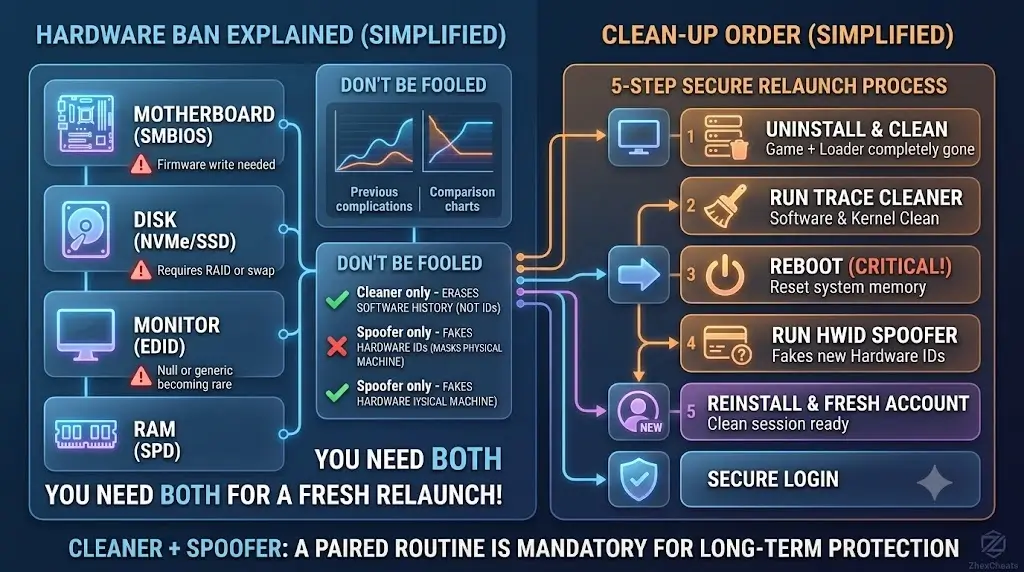
Hardware Bans Explained: Why a Software Spoofer Is Not Enough
A hardware ban fingerprints eight different components, from motherboard SMBIOS to monitor EDID. Here is what each layer actually checks and what closes the gap.
Jul 14, 2026Nathan ReedLeer artículo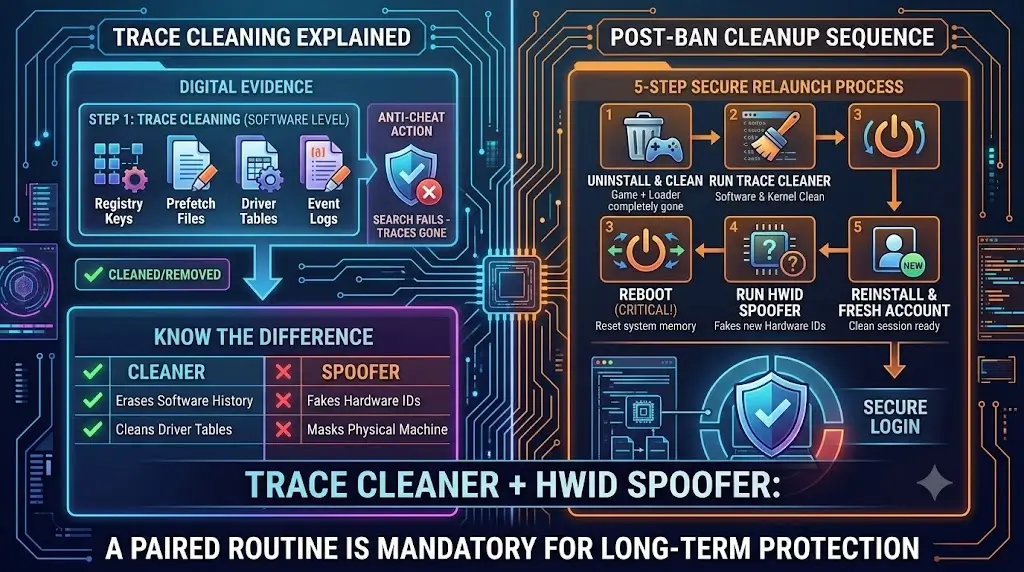 Game Hacking Guides
Trace Cleaning Explained: What Stays on Your PC After a Ban
Registry keys, prefetch files, driver load history: the records anti-cheat reads after a ban, and why a cleaner and an HWID spoofer are not the same tool.
Jul 14, 2026Nathan ReedLeer artículo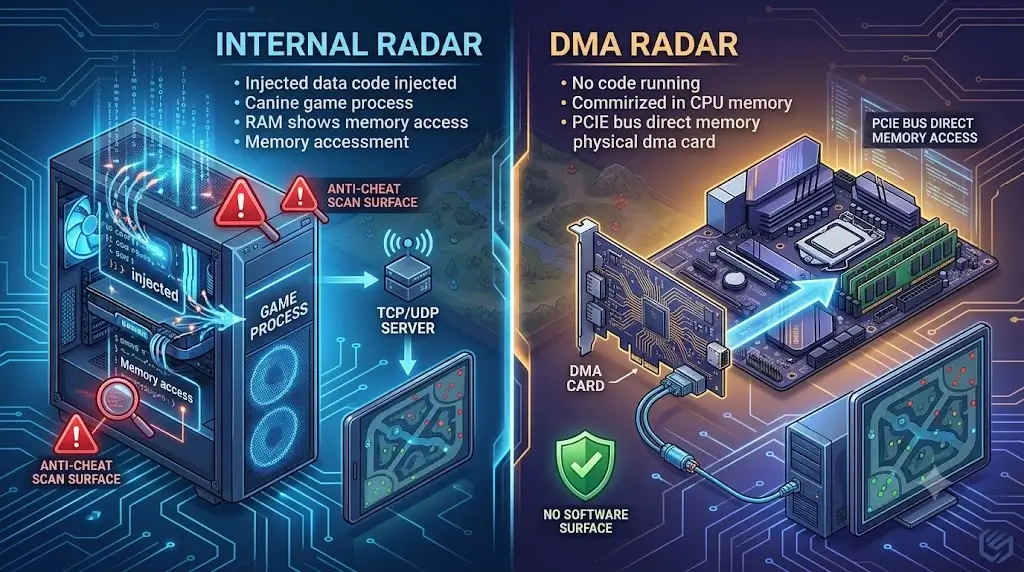 Game Hacking Guides
Radar Hack Explained: How the 2D Map Reads Every Player Position
A radar hack draws a second map that shows every player on the server in real time, without touching the game's renderer. Here is how it actually works.
Jul 12, 2026Nathan ReedLeer artículo Game Hacking Guides
How to Read a Cheat Vendor's Ban History (And Spot Fake Logs)
Days-undetected counters, patch logs and testimonials are trivial to fake. The eight signals that separate real vendors from rebranders.
Jul 11, 2026Nathan ReedLeer artículo