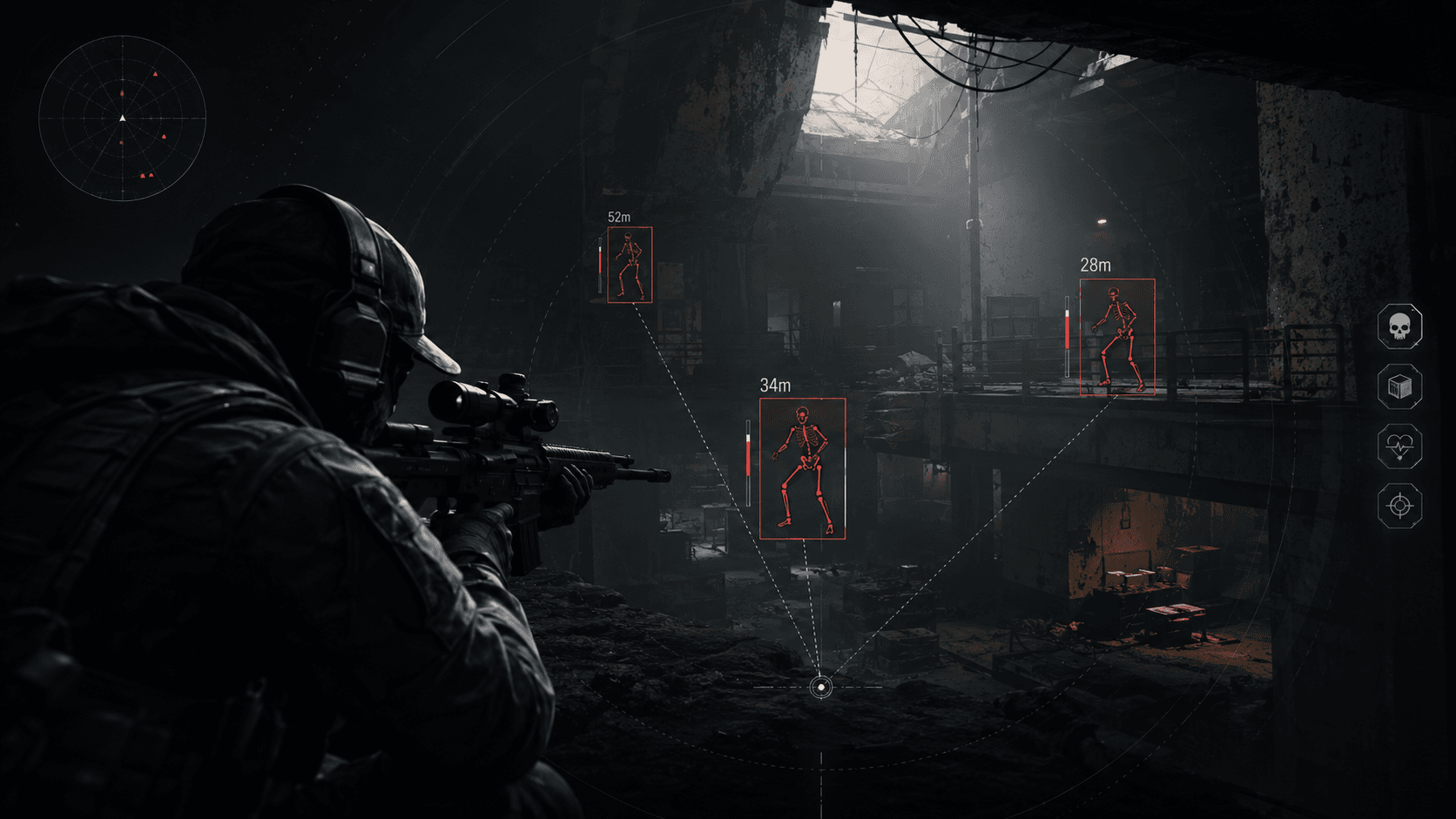
What ESP actually does to your screen
You push a corner and die to someone who was clearly pre-aiming your exact position through solid geometry. The killcam confirms it. That is ESP in action, and the mechanism behind it is a lot more interesting than "wallhack."
ESP stands for Extra Sensory Perception. In practical terms it is a transparent overlay window, the same dimensions as your game window, that draws real-time graphical data on top of everything you see. Enemy positions, health bars, item icons, skeleton outlines: all of it rendered as a second visual layer your opponents cannot see.
Unlike an Aimbot, ESP never touches your mouse. It only adds information to your display. That single distinction changes everything about how anti-cheat systems respond to it, and how you play with it.
The overlay architecture
There are two fundamentally different ways to draw an ESP overlay, and the difference matters for detection.
Internal rendering injects a DLL into the game process and hooks the graphics library directly, intercepting calls like glDrawElements or DirectX present functions. The overlay draws inside the game's own rendering pipeline. Fast and precise, but every integrity scanner looks specifically for hooks inside the game process.
External rendering runs as a completely separate process. It reads game memory from outside, calculates where enemies should appear on screen, and draws them into a transparent window that sits on top of your game. Nothing touches the game process itself. This is the architecture premium builds use.
World-to-screen: how 3D becomes 2D
The core technical problem every ESP build solves is coordinate projection. An enemy exists somewhere in a 3D world (X, Y, Z coordinates). Your monitor is a flat 2D grid of pixels. The ESP needs to know exactly which pixel corresponds to that enemy's position from your camera's current angle.
Games solve this with a View Matrix: a 4x4 matrix that encodes the camera's position, rotation, and field of view at any given frame. An ESP reads this matrix from game memory and runs the same projection math the game engine itself uses.
The result is precise screen coordinates for any object in the game world, updated every frame. This is what makes the overlay appear locked to enemies even as they move, crouch, or run behind cover.
Every visual element, explained
The overlay is not one thing. It is a set of independent data layers you can toggle on or off. Each draws from different memory offsets and serves a specific tactical purpose.
// ESP overlay elements
Bounding Box draws a rectangle around the enemy using their min/max projected screen coordinates. A 3D box traces the actual collision volume; a 2D box is simpler and less cluttered at range.
Skeleton ESP iterates through approximately 19 bone positions (head, spine, pelvis, shoulders, elbows, wrists, knees, ankles) and draws lines between them. You see the enemy's exact posture: crouching, prone, leaning left, vaulting. You know what they are doing before they appear in your viewport.
Distance is calculated as the Euclidean distance between your 3D position and the target's: the square root of the sum of squared differences on all three axes. Displayed in meters next to the box, it lets you instantly prioritize threats by range.
Spectator Warning detects when another player is spectating your POV and triggers an alert. Manual spectator reports are one of the most common triggers for account reviews; this feature gives you time to adjust your behavior before a report is filed.
Why ESP is harder to detect than Aimbot
Anti-cheat systems use two detection methods: signature scanning (looking for known cheat code) and behavioral analysis (looking for patterns that statistically cannot come from a human).
An Aimbot leaves behavioral evidence: snap movements at inhuman speed, reaction times below 50ms, headshot rates that are statistically impossible over a large sample. AI-based behavioral analysis flags these automatically. ESP produces none of that signal. You are still moving your mouse. Your aim stats look human because they are human.
The only behavioral tell for ESP is pre-aiming: turning toward enemies before line-of-sight is established through normal geometry. Premium builds address this with configurable visibility filters, letting you limit displayed information so your behavior stays within a statistically plausible range.
Game-specific overlay data
Generic box ESP is the baseline. Good builds go further by exploiting each game's unique memory layout to surface data that only matters in that title.
| Game | Unique overlay data |
|---|---|
| War Thunder | X-Ray ESP renders ammo racks, fuel tanks, and crew positions inside enemy vehicle hulls through armor geometry |
| Dead by Daylight | Aura overlay tracks generator repair progress, hook charge states, exit gate activation stage, and totem locations |
| Deadlock | Soul ESP shows orb spawn positions, timing windows, and jungle camp respawn counters on the overlay |
| Battlefield 2042 | Vehicle ESP displays type, health percentage, and active crew count for all tanks, helicopters, and jets |
| The Finals | Class ESP identifies enemy class (Light, Medium, Heavy) and tags active gadgets before a push |
| Escape from Tarkov | Loot ESP with keycard and rare barter filter; trace cleaner removes local session records after a raid |
| Dark and Darker | Rarity-filtered loot overlay hides vendor trash, surfaces only epic and legendary drops |
Loot ESP and extraction games
Extraction shooters like Tarkov, Gray Zone Warfare, DayZ, and Dark and Darker have their own category of ESP that goes beyond player tracking. In these games, information is the economy. Knowing where a keycard spawned before anyone else enters the room is worth more than any aim advantage.
Loot ESP reads item entity data from game memory and projects icons or text labels onto the overlay for every object in the current zone. Without filters, the screen fills with noise. Premium builds include a filter stack: minimum rarity threshold, mission-critical item list, minimum ruble or dollar value. With the right filters, you see exactly what matters and nothing else.
What separates a good ESP build
The overlay architecture determines everything else. These are the properties that separate builds that stay undetected from ones that produce bans inside a week.
- External rendering. Overlay drawn in a separate process, not via a hook inside the game. This removes the largest signature surface anti-cheat scans for.
- Accurate world-to-screen math. Boxes and skeletons that drift or misalign at angle are built on imprecise view matrix reads. Good builds maintain sub-pixel accuracy at all camera rotations.
- Configurable visibility filters. Control which entities appear, at what distance, and with which data fields. Less overlay noise; fewer pre-aim tells in your gameplay.
- Spectator Warning. Non-negotiable. Alerts you before a live viewer can build a report case against you.
- Fast patch cycles. Anti-cheat pushes updates weekly. Your provider needs to match that cadence or the build signature goes stale and detections spike.
- HWID Spoofer bundle. If a hardware ban lands, a spoofer is the only path back without replacing hardware. Better to have it before you need it.
The most effective setups pair ESP with a Triggerbot rather than a full Aimbot. ESP provides positional awareness; the Triggerbot fires when your crosshair overlaps a target naturally. No snap movements, no behavioral anomalies, and your aim statistics remain within a human range.
ZhexCheats ESP builds use external rendering across all supported titles: Tarkov ESP, Valorant ESP, CS2 Wallhack, and 20+ more games — all with Spectator Warning and HWID Spoofer bundled.
// Más artículos
 Game Hacking Guides
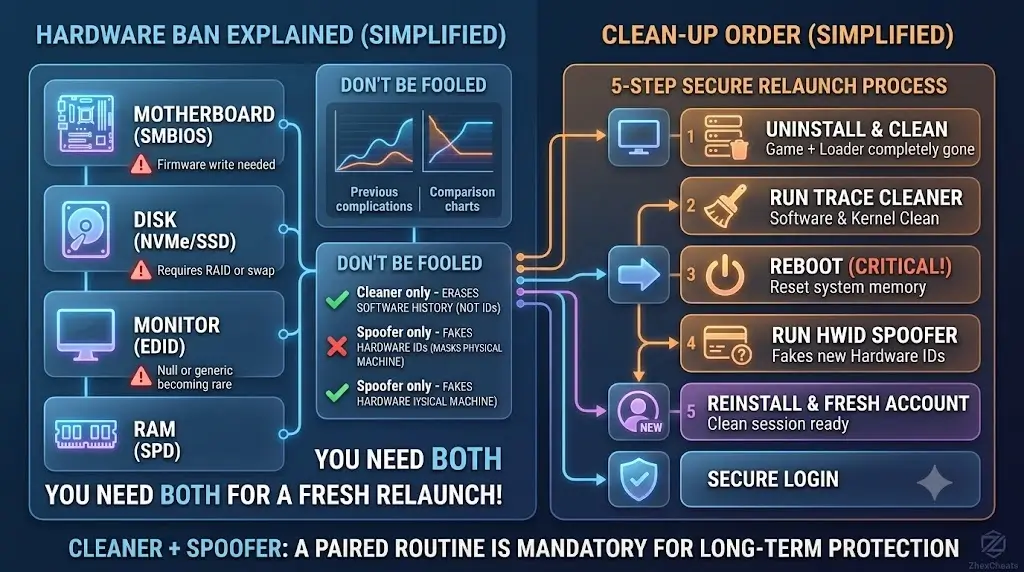
Hardware Bans Explained: Why a Software Spoofer Is Not Enough
A hardware ban fingerprints eight different components, from motherboard SMBIOS to monitor EDID. Here is what each layer actually checks and what closes the gap.
Jul 14, 2026Nathan ReedLeer artículo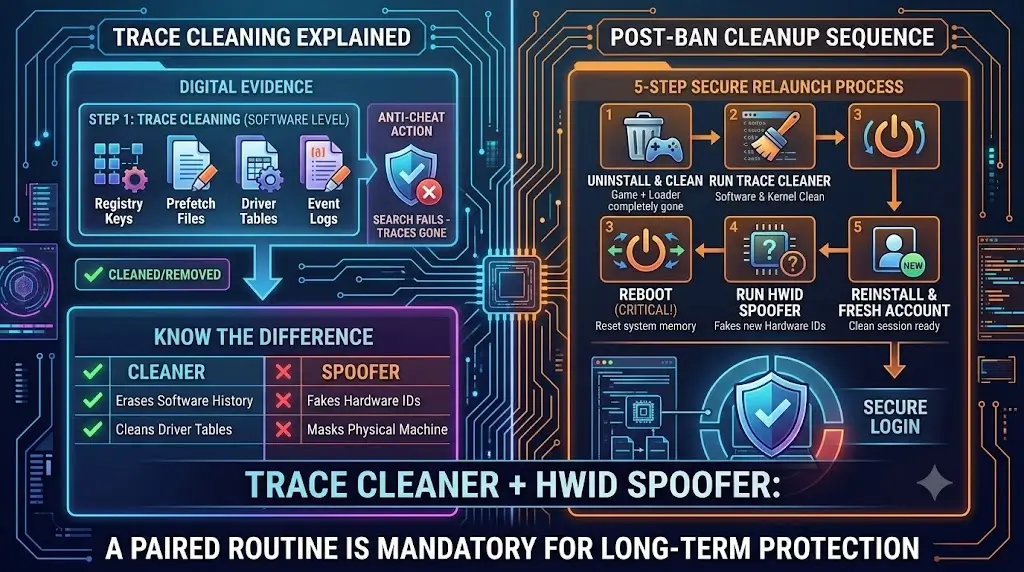 Game Hacking Guides
Trace Cleaning Explained: What Stays on Your PC After a Ban
Registry keys, prefetch files, driver load history: the records anti-cheat reads after a ban, and why a cleaner and an HWID spoofer are not the same tool.
Jul 14, 2026Nathan ReedLeer artículo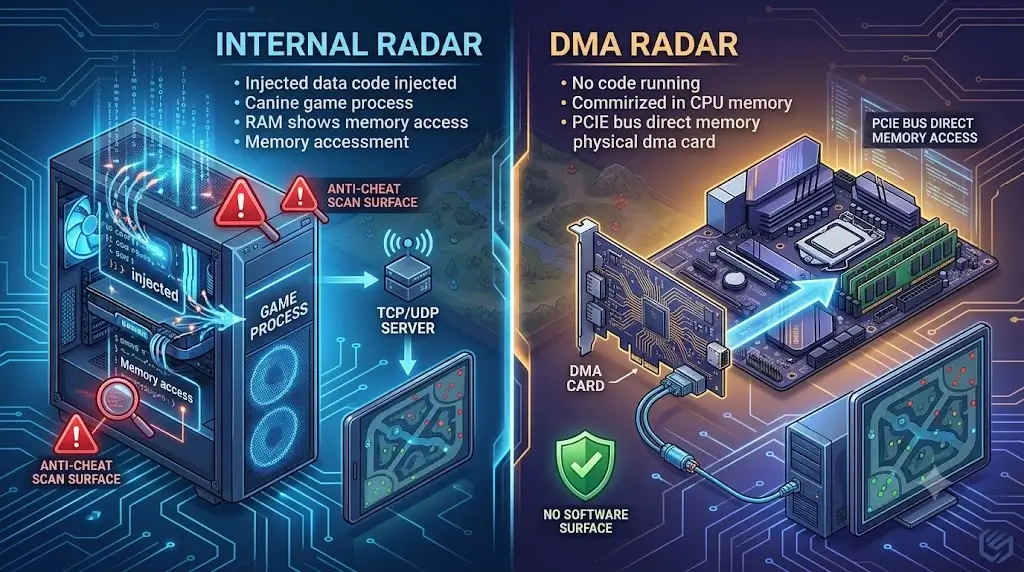 Game Hacking Guides
Radar Hack Explained: How the 2D Map Reads Every Player Position
A radar hack draws a second map that shows every player on the server in real time, without touching the game's renderer. Here is how it actually works.
Jul 12, 2026Nathan ReedLeer artículo Game Hacking Guides
How to Read a Cheat Vendor's Ban History (And Spot Fake Logs)
Days-undetected counters, patch logs and testimonials are trivial to fake. The eight signals that separate real vendors from rebranders.
Jul 11, 2026Nathan ReedLeer artículo