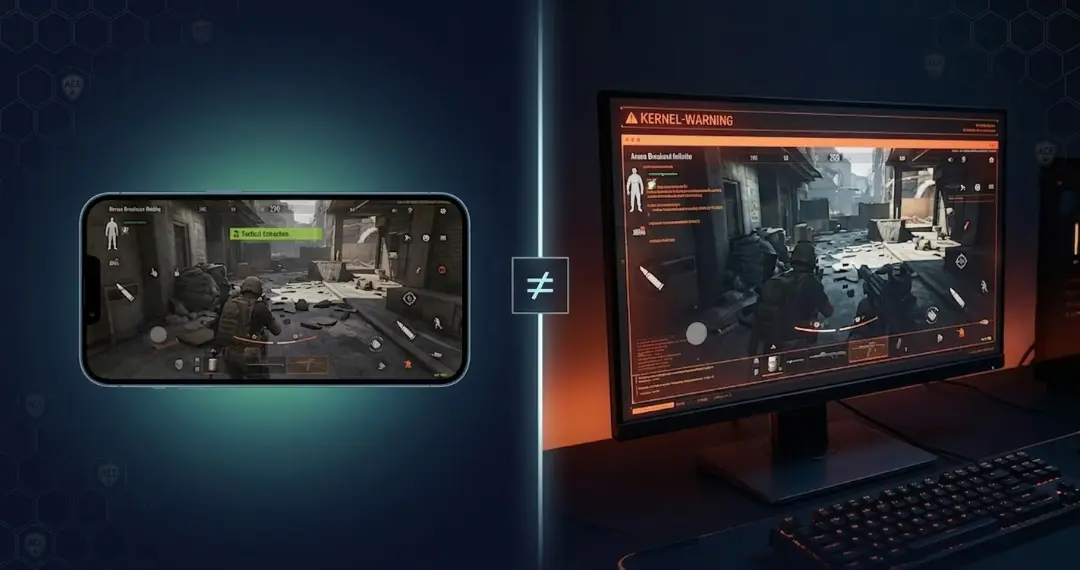
// device A
Arena Breakout
Mobile, Tencent Games
Anti-cheat: ABM in-app layer
Threat surface: APK, virtual space
Cheat scene: GameGuardian, modded APK
// device B
Arena Breakout: Infinite
PC, Tencent / MoreFun Studios
Anti-cheat: ACE, kernel Ring-0
Threat surface: kernel, DMA, internal
Cheat scene: private internal builds
Two Games, One Name, Two Anti-Cheats
Arena Breakout and Arena Breakout: Infinite share a title, a publisher, and a setting. They share almost nothing else from a cheat-architecture standpoint. The mobile game runs on Android and iOS with an in-app anti-cheat layer designed around the realities of a sandboxed mobile OS. The PC release runs ACE, Tencent's kernel-level anti-cheat, with a completely different threat surface, a completely different ban math, and a completely different cheat scene supplying it.
Most of the confusion in the buyer market comes from treating these as one product with two skins. They are not. A "cheat" that works on one is, in practice, not a cheat at all on the other. The detection layers are not just different in degree. They are different in kind.
This piece breaks down how each side actually handles cheats, where the two systems diverge, and why a mobile-rooted player walking into the PC ecosystem with the same mental model gets banned almost immediately.
The Mobile Side: APK Modding, GameGuardian, Virtual Spaces
Android is a permissive operating system. Apps run inside a sandbox, but a rooted device, a virtualised app container, or a custom recovery image can break that sandbox in ways no equivalent exists for on a stock PC. The mobile cheat scene for ABM exists almost entirely inside that gap.
// Common ABM cheat categories, by entry point
ABM's first line of defence is integrity. The client checks its own APK signature on launch, looks for known root indicators, scans the running process list for tools like GameGuardian, and watches for hooking frameworks like Frida or Xposed. Most of the loud techniques on that list die at this stage. A modded APK fails signature verification before the first match loads. GameGuardian gets caught by package-name scans during the session and queues the account for review.
The mobile cheat market keeps moving because the ecosystem keeps shifting. New rooting tools, new hide-root methods, new virtual space apps. Detection follows, often within days. That cycle is loud, fast, and visible. It is also a completely different fight than the one happening on ABI.
ABM's Real Layer Is Behavioral, Not Emulator Blocking
Players assume mobile anti-cheats treat emulators as enemy number one. Tencent's mobile titles, ABM included, do not. The integrity layer cares about what is hooked into the process and what files are on the device. The behavioral layer cares about how you play. Whether you launched the game on a real phone or inside Bluestacks does not move either dial much, as long as the input and play patterns stay within human range.
The actual flag generators are different.
| ABM detection layer | What it catches | Typical outcome |
|---|---|---|
| APK integrity | Modded binaries, repackaged installers | Instant ban on launch |
| Process / tool scan | GameGuardian, Frida, known hook frameworks | Session flag, deferred ban |
| Root / virtual-space heuristics | Root daemons, dual-app containers without hide | Warning tier, repeat flag escalates |
| Input pattern analysis | Macros, autoclickers, perfect-recoil scripts | Behavioral flag, queues for ban wave |
| Statistical play analysis | Impossible accuracy curves, prefire across walls | Manual review, lifetime ban risk |
Macros are the single largest source of ABM bans that do not involve a modded client. Recoil-control macros produce inhuman timing variance. Autoclickers in loot scenes produce inhuman selection latency. Even randomised macros leave statistical fingerprints that the behavioral layer reads cleanly. Tencent has been public about this design choice: input pattern analysis catches what process scans miss, regardless of whether the input came from a touchscreen, a Bluetooth controller, or an emulator's keyboard mapping.
That is why "use an emulator and you get banned" is not actually true for ABM. The emulator itself is not the trigger. What you do inside it is.
The Emulator Loophole That Confuses Everyone
Run ABM inside Bluestacks or LDPlayer with the native mobile client and a normal mouse-and-keyboard input mapping, and the anti-cheat treats it like a mobile session. The integrity checks pass because the APK is the official one. The process scans pass because the host is the emulator, not the cheat runtime. The behavioral layer is the only thing that matters, and human-paced input clears it.
// the actual emulator policy, plain reading
✓ Android emulator running the official ABM mobile client, normal input
✓ MFi controllers, certified Bluetooth gamepads
! Emulator + macro layer for recoil control or auto-loot, flagged
✗ Emulator + modified APK or memory-editor script, banned
✗ PC-native ABI client treated as a mobile session, account-level penalty
That last line is where the loophole closes. The PC client is not "ABM with a desktop window." It is a different product, with a different anti-cheat (ACE) sitting at Ring 0. The moment a player tries to log a PC-bought ABI account through the mobile pipeline, or tries to use mobile-style tooling against the PC client, the boundary becomes visible.
This part trips up players coming from the mobile cheat scene with the assumption that what worked on a rooted phone or a virtual space will work on a desktop install. It does not, because ACE is not playing in the same league as the mobile integrity layer. The PC side is a kernel anti-cheat fight, and the mobile toolset has no answer for kernel.
The PC Side: ACE Kernel Mode and What Changes
ACE loads before the game does. It runs at Ring 0, the kernel privilege level, with the same access rights as the operating system itself. From that position it can enumerate every running process, inspect memory regions across the system, intercept handle requests through ObRegisterCallbacks, and watch driver loads with signed-driver enumeration. None of that is available to the mobile integrity layer, because Android does not let an app reach there. ACE is a fundamentally different category of system.
// ABM defence stack
1. APK signature check
2. Root indicator scan
3. Process / package enum
4. Frida / Xposed detection
5. Input behavioral layer
// ABI / ACE defence stack
1. Kernel module on boot
2. Handle interception, ObRegisterCallbacks
3. Driver enumeration + HVCI blocklist
4. Module signature DB scan
5. Sub-millisecond aim telemetry
The two stacks share exactly one layer: behavioral analysis on player input. Every other layer is doing a different job at a different privilege level against a different attack class. Modded APKs do not exist on PC. Virtual spaces do not exist on PC. GameGuardian does not exist on PC. The tools that define the ABM cheat scene have no equivalent in the ABI ecosystem because the underlying OS does not give them anywhere to live.
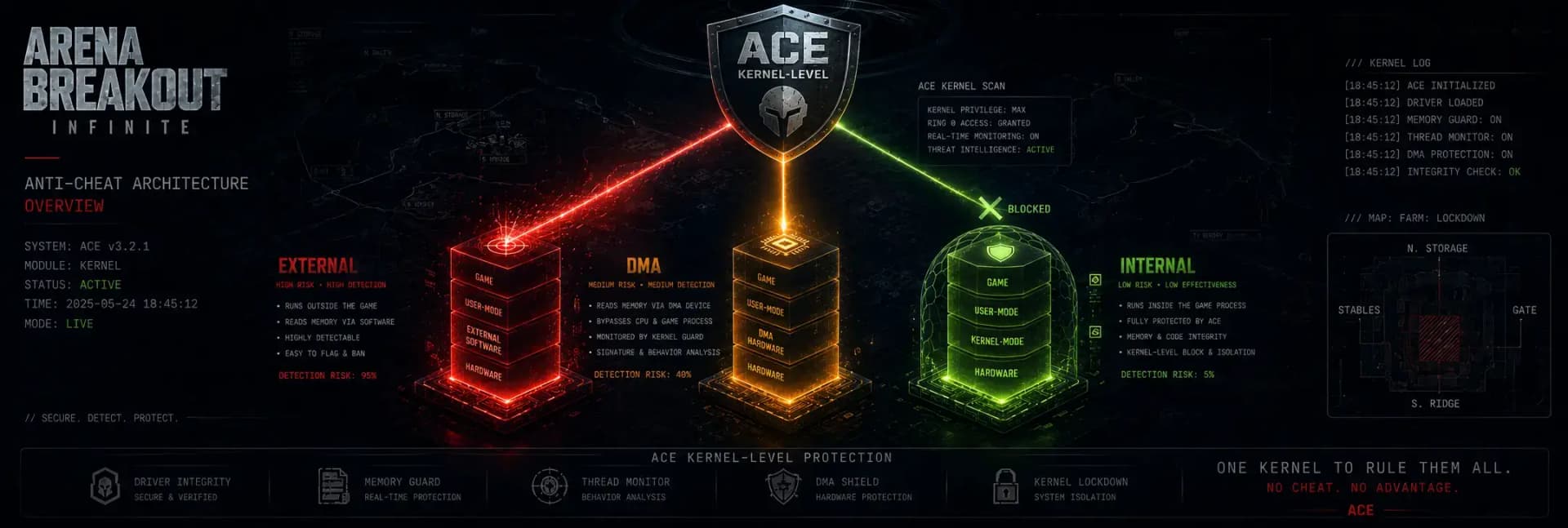
The ABI cheat scene runs on internal DLL builds and external read pipelines, with a small high-end DMA segment on top. The full architectural breakdown is in the ABI cheats explained guide, which covers how ACE handles each of those three categories in turn.
Why Mobile Cheats Cannot Port to ABI
The instinct of a long-time ABM cheater walking into ABI is to ask which mobile cheat works on PC. None of them do. The reasons are architectural, not legal.
A modded APK is an Android package. PC Windows does not install or execute APKs against a native game binary. GameGuardian is an Android-only memory editor that uses Android-specific syscalls to read another process's memory. Those syscalls do not exist on Windows. Frida runs on PC too, but a Frida hook against an ACE-protected process gets caught by the same handle and memory-region scans that catch any other usermode injector.
The crossover that buyers sometimes assume exists, "the mobile version of the cheat" or "the desktop port," is marketing. It is not architecture. A cheat that works on ABI was written from scratch for ABI: against ACE, against Ring-0 detection, with a per-subscriber binary, with humanization tuned for ACE's behavioral thresholds. A cheat that works on ABM was written for the mobile integrity layer with virtual-space evasion, root hiding, and input-macro masking. The skillsets, the toolchains, and the buyer infrastructure are separate industries.
If a vendor advertises "Arena Breakout cheat" without specifying Mobile or Infinite, treat that as a red flag. The two products have nothing technically in common from a cheat-build standpoint. A single SKU covering both either does not exist, or it works for neither.
The Crossover Trap: Mobile Habits on PC Accounts
Even players who buy the right cheat for the right platform sometimes get banned by importing the wrong habits. The mobile cheat scene has soft norms that work because the mobile anti-cheat is permissive in places ACE is not. Those norms become liabilities on PC.
Three of them come up repeatedly.
First, the "try free first" pattern. On ABM, downloading a free cheat from a Telegram channel to test before paying is a common entry behavior. The ban risk is the device, not the account, because mobile reinstalls are easy and HWID is barely tracked. On ABI, running any free cheat means running a binary that hit ACE's signature database within hours of release. The account is gone within one ban wave, and the hardware identifiers are now tagged.
Second, the "all features on, always" pattern. Mobile cheats often run with every feature enabled because the layer that watches behavior is forgiving compared to kernel-level telemetry on PC. On ABI, ACE's behavioral layer reads sub-millisecond aim transitions. Running raw aimbot at full strength every match produces a movement signature ACE flags fast. Subtle settings, lower aim strength, smoothed transitions, conservative FOV: those exist on PC because ACE punishes the opposite. They are not optional.
Third, the "spoof if I get banned, try again" pattern. On mobile, a banned account is a $2 problem and a new device fingerprint is one factory reset away. On ABI, hardware identifiers, disk serial and MAC at minimum, are logged at the moment of ban. A new account on the same machine with no spoofer matches within a single session and gets caught in the next batch. Habits that were cheap on mobile become expensive on PC.
Choosing the Right Lane for the Game You Actually Play
The fork is simple, even if the buyer market makes it confusing. Mobile players stay in the mobile cheat ecosystem with all the tradeoffs that implies: cheap, fast cycles, frequent reinstalls, a process scan to dodge per session. PC players play a fundamentally different game where the cheat is a long-term subscription, a private internal build, and a humanization profile tuned against ACE.
If the plan is to switch from ABM to ABI, the cheat budget restarts at zero. Whatever was paid on mobile does not carry over. Whatever worked on mobile does not work on PC. The Tarkov-style PC extraction loop is the actual product, and the cheat that fits it is built for it from the kernel up.
The ZhexCheats Arena Breakout: Infinite module is built specifically for the PC environment described above. Private internal architecture, per-subscriber binary, humanization calibrated for ACE's behavioral layer, panic key and HWID spoofer in the same install. It is the right tool for the PC side of the fork, and it is not interchangeable with anything on the mobile side, because nothing on the mobile side could ever survive what the PC side gets scanned by.
One name. Two games. Two cheat industries that almost never overlap. The right choice starts with knowing which one you are actually playing.
// Más artículos
 Arena Breakouts
Arena Breakout Cheats Explained: Internal, External & DMA in 2026
Tencent's ACE treats Arena Breakout cheats differently than BattlEye does. Three architectures, three risk profiles, and the lane most players guess wrong.
May 28, 2026Nathan ReedLeer artículo Arena Breakouts
30 Days Inside ABI's Anti-Cheat: What Actually Gets You Flagged
Arena Breakout runs ACE and BattlEye at the same time. I spent 30 days testing both layers and tracked exactly what flagged, what didn't, and when the ban landed.
May 22, 2026Nathan ReedLeer artículo