What is an Aimbot?
You've seen it in killcams. Cursor snaps directly to a head, the shot lands before the enemy finishes turning, and the whole clip looks like it belongs in a robot movie. That's an Aimbot at its most obvious setting.
At its core, an Aimbot is software that helps your cursor find an enemy automatically. Some versions snap instantly. Others follow the target so gently that watching the replay looks completely normal. The difference comes down to configuration. And configuration is exactly what separates a ban in three hours from an account that runs for months.
This article breaks down every layer, from the simplest concept to the hardware-level techniques used in the most advanced builds available today.
How games store player data
Every online game keeps its world state in system memory. Player entities live there as structured objects: position vectors, bone matrices, team IDs, health values. An Aimbot reads those objects at runtime to find enemies before the renderer even draws them on screen.
The read loop runs every frame. It scans the entity list, filters for live enemies, calculates their 3D world position, then projects it onto your 2D screen. That projection gives an exact pixel coordinate. The software moves your mouse there.
Speed is everything here. Good software runs this loop at your monitor's refresh rate, 144 Hz or 240 Hz. Slow loops miss fast-moving targets. The math is cheap; the bottleneck is always memory access latency.
Bone selection, where to aim
Players aren't a single point. They're skeletal meshes with 20 to 60 bones. Where the Aimbot aims determines kill speed and how suspicious the movement looks. Bone selection is one of the most consequential settings in any premium package.
// Bone priority map
Head-only locking is fast and lethal. It is also what kills accounts on Vanguard and BattlEye within hours; the movement signature is unmistakable. Chest targeting with slight randomization is what premium Valorant and CS2 builds default to. Kills land clean; the pattern reads human.
Smoothing and humanization
Raw aim correction is instant. Zero milliseconds. That is the problem. Anti-cheat replay systems flag snap movements immediately because no human does that. Smoothing interpolates the correction over time, giving the cursor a curved arc instead of a teleport.
Humanization goes further. It adds micro-jitter to replicate natural hand tremor, introduces slight overshoot-then-correct patterns, and varies the correction curve by distance to target. The goal is a mouse movement distribution that matches a real player's histogram, noisy, not perfect.
Advanced builds also add recoil compensation. The software reads the weapon's recoil pattern from memory and applies an opposite correction vector per shot, holding your crosshair on target through a full spray. Combined with smoothing, this is nearly invisible in replay analysis.
Triggerbot: fire-on-detection
A Triggerbot does not move your mouse at all. It watches one thing: whether your crosshair overlaps an enemy hitbox. When it detects overlap, it fires. Simple, effective, and hard to prove.
Because there is zero aim correction, anti-cheat systems have almost nothing to analyze. Shots register at positions your mouse was already at. The only tell is reaction time. Humans average 150 to 250 ms from visual stimulus to click; a Triggerbot fires in 1 to 10 ms. Premium builds add configurable delay, typically 50 to 120 ms, to stay inside the human reaction window.
The Valorant-specific Triggerbot builds are popular because Vanguard has strong aimbot detection but historically weaker Triggerbot detection. Manual aim combined with fire-on-overlap produces stats that look aggressive but plausible.
Execution layers: usermode vs kernel vs DMA
Where the cheat runs determines how hard it is to detect. Three tiers exist. Each step down the stack adds cost and complexity but dramatically increases survival time.
| Layer | How it runs | Detection risk | Cost |
|---|---|---|---|
| Usermode | Standard ring-3 process. Anti-cheat can enumerate and scan it directly. | High | $ |
| Kernel driver | Ring-0 driver. Reads memory without a user-space process. Harder to enumerate; can hook system calls. | Medium | $$ |
| DMA hardware | Separate PCIe card reads the game PC's RAM over the bus. Zero software footprint on the host. | Very low | $$$ |
DMA setups use a second computer. The game PC has a PCIe card installed; a second machine reads its memory over that card via Leech-DMA or similar firmware. No driver runs on the host, so Vanguard and BattlEye scan literally nothing. The only viable detection vector is behavioral: in-game statistics or manual killcam review.
Kernel-level builds use BYOVD (Bring Your Own Vulnerable Driver) to load unsigned code at ring 0. This was the dominant technique before Microsoft tightened DSE enforcement in Windows 11 24H2. Some builds still work; they target specific Windows build versions.
Detection risk by method
The gap between free software and premium kernel builds is real. Free cheats share signatures across thousands of users; one anti-cheat update wipes the entire base simultaneously. Premium builds are maintained by small teams who push signature patches faster than anti-cheat can scan.
What "premium" actually means
Premium is not just a price tag. Specific properties separate products that last from ones that get everyone banned on the same Tuesday.
- Private distribution. Limited seat counts mean fewer users sharing a signature. Detection data pools stay small.
- Fast patch cycles. When BattlEye or Vanguard updates, a quality provider ships a patch within hours.
- Hardware-backed options. DMA support or kernel builds with valid driver signing bypass most software-side scanning entirely.
- Configurable humanization. Smoothing, jitter, FOV limits, and reaction delay tuned per-weapon.
- Spoofer bundle. HWID Spoofer included so hardware bans do not stick.
The real cost of cheap software is not the ban itself. It is the hardware ban that follows. A good HWID Spoofer costs more than one month of premium access. Buying cheap ends up costing more.
ZhexCheats carries kernel-tier builds with full humanization, bone selector, Triggerbot, and HWID Spoofer. Available for Valorant, CS2, Tarkov, and 20+ more titles.
// Weitere Artikel
 Game Hacking Guides
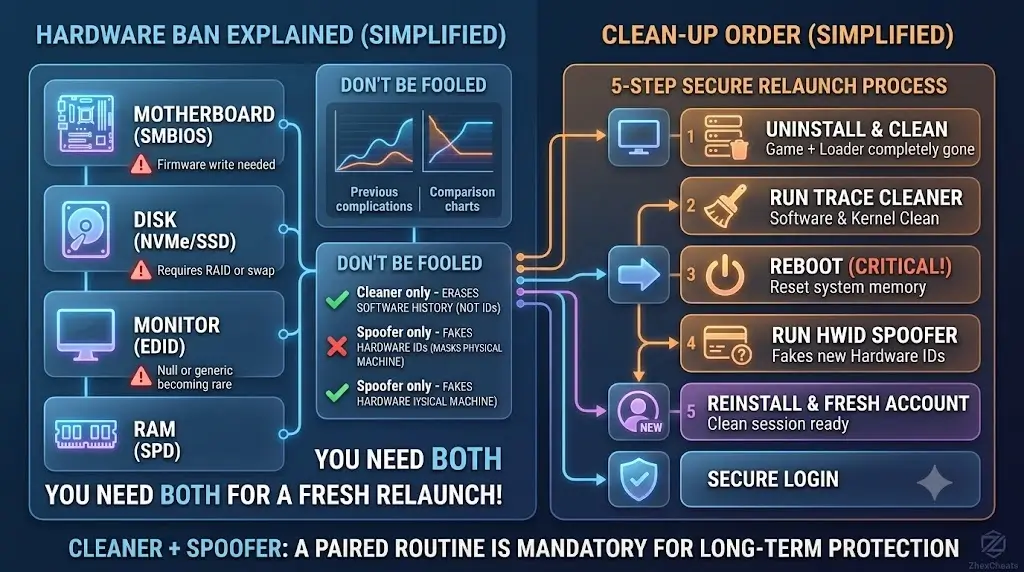
Hardware Bans Explained: Why a Software Spoofer Is Not Enough
A hardware ban fingerprints eight different components, from motherboard SMBIOS to monitor EDID. Here is what each layer actually checks and what closes the gap.
Jul 14, 2026Nathan ReedArtikel lesen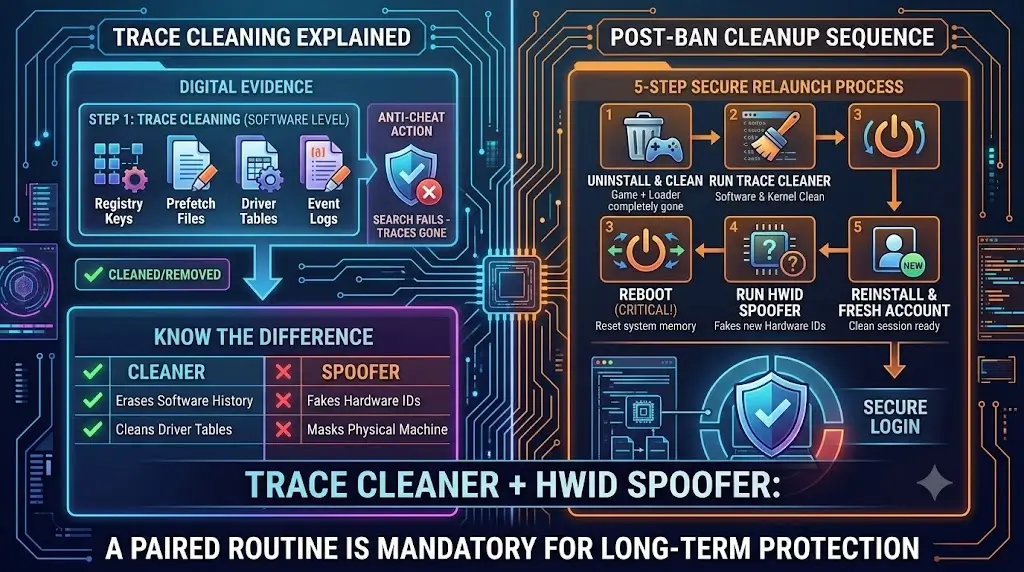 Game Hacking Guides
Trace Cleaning Explained: What Stays on Your PC After a Ban
Registry keys, prefetch files, driver load history: the records anti-cheat reads after a ban, and why a cleaner and an HWID spoofer are not the same tool.
Jul 14, 2026Nathan ReedArtikel lesen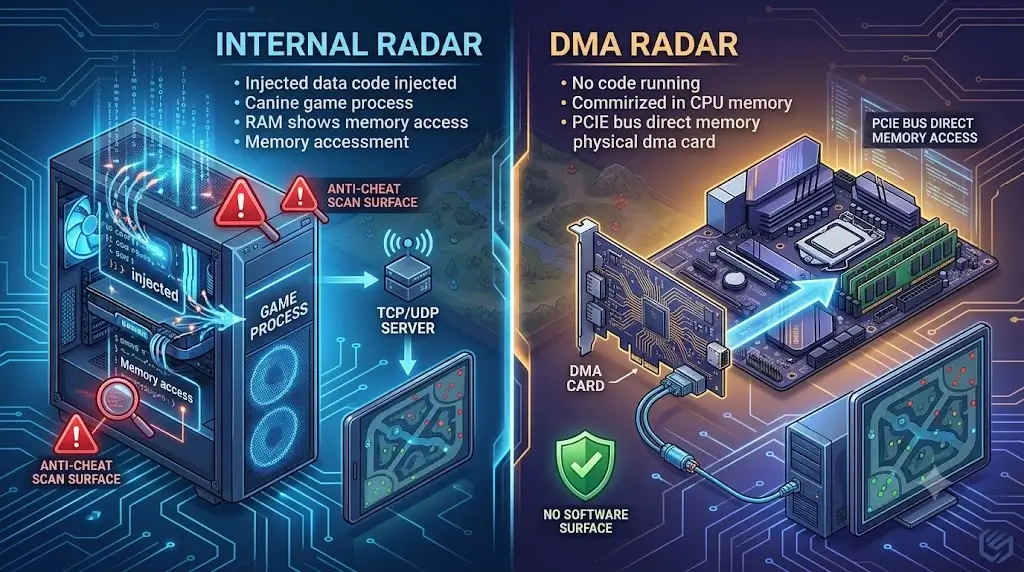 Game Hacking Guides
Radar Hack Explained: How the 2D Map Reads Every Player Position
A radar hack draws a second map that shows every player on the server in real time, without touching the game's renderer. Here is how it actually works.
Jul 12, 2026Nathan ReedArtikel lesen Game Hacking Guides
How to Read a Cheat Vendor's Ban History (And Spot Fake Logs)
Days-undetected counters, patch logs and testimonials are trivial to fake. The eight signals that separate real vendors from rebranders.
Jul 11, 2026Nathan ReedArtikel lesen