What an AI aimbot actually is
A traditional aimbot reads enemy positions out of game memory. It calls a Windows function, asks the operating system to hand it a pointer into the running game process, walks the object list, finds the player entities, and computes the aim vector. Every step of that chain is something a kernel anti-cheat can watch. Most of them do.
An AI aimbot does none of that. It never opens a handle to the game. It never reads game memory. It never loads a driver. The game process and the cheat process do not even run on the same computer.
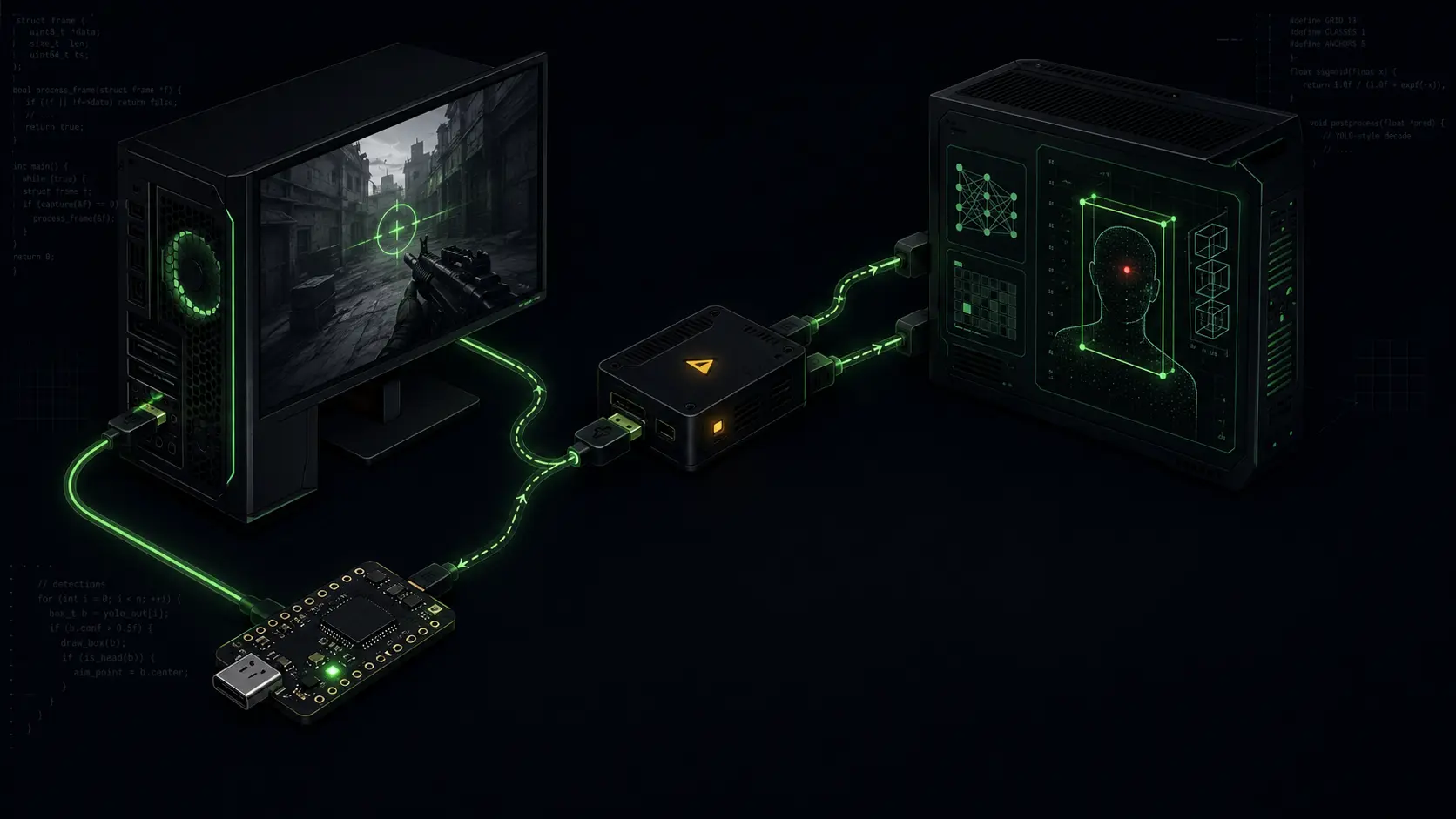
What it does instead is look at the screen. A second machine watches the video output of the gaming PC, runs a neural network on each frame, finds the enemy heads with computer vision, and tells a small USB device to nudge the mouse. The gaming PC sees a USB mouse moving. That is the entire attack surface visible to Vanguard, BattlEye, EAC, or Ricochet.
This is why the category exists. Kernel anti-cheats spent a decade getting better at watching the operating system. AI hardware cheats answered by leaving the operating system entirely.
The two-PC setup: capture, infer, inject
The hardware stack is the thing most players have never seen explained clearly. There are four physical components, and each one has a specific job.
The game PC runs the game normally. Nothing is installed on it. The capture card sits between the game PC's GPU output and the monitor, mirroring the video signal over USB or PCIe to the second machine. The second PC runs the AI model. The input emulator, almost always a KMbox or MAKCU device, plugs into the game PC by USB and announces itself as an ordinary HID mouse.
// END-TO-END PIPELINE, GAME-PC PERSPECTIVE INVISIBLE
01
Game PC
GPU renders frame, sends to HDMI out
~0 ms
02
Capture card
Splits signal, streams to second PC
~6 ms
03
YOLO inference
Frame to head bounding box on GPU
~4 ms
04
Humanize path
Bezier curve plus motor jitter
~2 ms
05
KMbox to game PC
HID mouse packet over USB
~1 ms
Total budget < 15 ms. Above that, head tracking falls behind player movement.
The capture card matters more than people think. It draws the video signal off the HDMI line at the cable level, which means no software on the game PC ever sees a screen-capture request. Vanguard's ScreenAccess monitor catches OBS, NVIDIA ShadowPlay, and every Windows Graphics Capture API call. It does not catch a passive HDMI splitter, because there is nothing on the wire to catch.
Same logic applies to the input side. The KMbox shows up to Windows as a Logitech mouse or a Razer mouse with the right vendor and product IDs. The game PC has no way to know that on the other end of the USB cable there is a microcontroller taking orders from a neural network instead of a human wrist.
How YOLO finds a head in four milliseconds
YOLO stands for You Only Look Once. It is the family of neural networks that made real-time object detection possible on consumer GPUs. The original paper was published in 2016. The version most AI aimbots run today is YOLOv5 or YOLOv8, with some premium setups moving to YOLO-NAS for the extra precision.
The model is trained on screenshots of the specific game. For an Escape from Tarkov setup, the training set will include thousands of labeled frames covering every player model, every armor configuration, and every map. The label is a bounding box around the head. After training, the model takes a 640 by 640 pixel image as input and returns a list of boxes with confidence scores.
On a midrange GPU like an RTX 4060, a single YOLOv5s inference takes about 4 milliseconds. Add the time to copy the frame from capture card to GPU memory, postprocess the boxes, and select the target closest to crosshair, and the inference stage of the pipeline lands somewhere between 5 and 8 milliseconds. That number is the difference between an aimbot that tracks moving targets and one that drifts behind them.
The output looks like this. Centre X, centre Y, width, height, confidence. Five numbers per detection. The cheat logic picks the highest-confidence head box inside the configured FOV and sends the delta from current crosshair position to that box centre to the next stage.
Training data is what separates a working AI aimbot from a useless one. A model trained on Valorant agents does not detect Tarkov scavs. A model trained at 1920x1080 falls apart at 2560x1440. Vendors with serious operations maintain separate models per game, per resolution, per major patch. That is why pricing on private AI setups runs into the thousands of dollars.
Bezier curves and motor jitter
Knowing where the head is solves half the problem. The other half is moving the mouse there without looking like a robot. Straight lines get accounts banned. So do parabolic curves with no jitter. So does any movement that completes in under 100 milliseconds, because human flick reactions almost never resolve that fast.
The humanization stage is where AI aimbots either pass behavioural review or fail it. The path from current crosshair to target head is generated as a cubic Bezier curve, with control points chosen to mimic the natural overshoot-and-correct pattern human aim follows. Then motor noise is layered on top, a small random jitter that approximates the natural tremor of a hand on a mouse.
// MOUSE PATH FROM ORIGIN TO TARGET, 240 PX
Linear paths fail Vanguard's first-pass behavioural filter. The Bezier-plus-jitter signature is the minimum credible humanization.
What the picture does not show is timing. A real human reaching across 240 pixels does it in 180 to 260 milliseconds, with acceleration peaking around the 40 percent mark and decelerating into the target. A naive aimbot does it in 30 milliseconds at constant velocity. The behaviour gap is the entire detection signal.
Good AI aimbots scale their movement time with distance. Short flicks resolve fast, long flicks take longer, and the deceleration curve mimics the Fitts's Law profile that hand movement naturally follows. Bad ones use a fixed speed setting and ban inside a week.
SVD and the rank-1 mouse signature
Riot Games published research in 2023 on the technique Vanguard now uses to flag scripted mouse input. The method is called Singular Value Decomposition, or SVD. It is a linear algebra operation that takes a matrix of mouse samples and breaks it into components ranked by how much of the signal energy each one explains.
The intuition is this. A human moving a mouse generates motion in many directions at once. Forward, slightly sideways, with vertical micro-corrections from the wrist. The motion matrix is what mathematicians call full-rank, meaning no single component captures most of the energy. A scripted aimbot moving on a straight line, by contrast, puts almost all of its energy into one direction. The matrix is rank-1.
SVD pulls this out as a number. Specifically, the first singular value, called E1, expressed as a percentage of total energy. Human mouse movement usually sits at E1 around 88 to 94 percent. Linear-script aimbots come in at E1 above 98 percent. The gap is small, but it is consistent across millions of samples, and it is what trains the classifier.
// E1 ENERGY DISTRIBUTION, FIRST SINGULAR VALUE OF MOUSE MOTION MATRIX
Energy spread across rank-2 and rank-3 components, passes filter cleanly.
Borderline zone. Survives individual samples, accumulates suspicion over weeks.
Flagged in the first 500 samples. Ban lands inside the next enforcement window.
This is why the humanization stage is non-negotiable. A KMbox sending perfectly straight motion packets at 1000 Hz is a rank-1 matrix dressed up as a Logitech mouse, and the classifier learns to spot it the same week it ships.
It is also why the gap between cheap and expensive AI setups exists. Adding Bezier curves is easy. Tuning the curves so the resulting E1 distribution sits inside the human envelope, across different sensitivities and DPI settings and distance buckets, is the hard part. Vendors who get that right charge for it.
What anti-cheats still have left
The marketing line on AI hardware cheats is that they are undetectable. That overstates the case. The game PC sees a USB mouse, yes. But anti-cheat developers have not been sitting still since 2021, and they have built three new lines of defense that target this category specifically.
Reaction time outliers. No human reacts to a peeking enemy in under 130 milliseconds. The neurological floor for a flash-and-shoot motor response is around 150 ms in trained esports players, and the average sits closer to 220. An AI pipeline that fires at 90 ms triggers a server-side flag every time it happens. Repeat the flag often enough and the account moves into the deferred review queue.
Tracking smoothness under unpredictable motion. When a target jumps, crouches, and strafes in rapid succession, human aim breaks down briefly. The crosshair lags behind, overcorrects, lags again. AI aim does not. It stays locked. Riot calls this metric "tracking stickiness under derivative discontinuity" in their blog posts. It is a strong enough signal that some Valorant Immortal accounts have been banned purely on tracking analytics with no software detection at all.
HID device fingerprinting. KMbox firmware presents itself as a known mouse, but the timing of its USB reports is too regular. A real Logitech mouse polls at 1000 Hz with jitter of plus or minus 80 microseconds, because the USB controller has to share bus time with everything else on the system. A KMbox often polls at 1000 Hz with jitter under 5 microseconds. That difference is detectable from the game PC side without any kernel driver, just by timestamping HID interrupts.
This is also where games like Tarkov, PUBG, and Arena Breakout are catching up. BattlEye's behavioural module logs every HID interrupt timestamp to its server-side telemetry, and the analytics team correlates polling regularity against ban history at the population level. Arena Breakout cheats face the dual-layer ACE plus TenProtect setup, which adds a second telemetry feed and a separate review pipeline on top of BattlEye-style USB analysis.
None of this is fatal to the category. AI vendors counter with deliberate USB jitter, throttled polling, and randomized report intervals. But the cat-and-mouse is real, and the ceiling for sloppy implementations keeps dropping.
What this means for buying an AI aimbot in 2026
If you are reading this because you have seen the YouTube videos and wondered whether the technology actually works, the short version is yes. AI aimbots with capture cards and KMbox-style input devices do bypass software-level anti-cheat. The game PC genuinely cannot see them. Vanguard, EAC, BattlEye, and Ricochet are blind to the cheat process because there is no cheat process on the machine they are running on.
The longer version is that the category has three serious caveats. First, it is expensive. A complete setup with a capture card capable of low-latency mirroring, a second PC with a GPU strong enough for sub-10 ms inference, a quality input emulator, and an actually-tuned model runs into four-figure territory before you fire a single shot. Second, behavioural detection is real and getting better. Reaction time outliers, tracking smoothness, and HID polling fingerprints are all signals the game PC can collect without seeing the cheat itself. Third, the vendor matters more than the tech. Two products built on the same YOLO base can have completely different ban histories depending on how well the humanization layer is tuned.
For most players, the practical takeaway is that AI hardware cheats are a premium category aimed at specific games where kernel anti-cheat has closed every other door. Tarkov, PUBG, Arena Breakout, and Valorant are the four titles where this technology has any real reason to exist, because the conventional Escape from Tarkov cheats and PUBG cheats market still has plenty of working internal and external options that cost a fraction of an AI build.
The right question is not "is AI undetected." It is "is the gap between AI and a properly maintained private internal cheat actually worth the price difference." For most players in most games, the answer is no. ZhexCheats keeps both categories in stock for a reason; the harder the anti-cheat, the more the hardware route earns its premium, and the easier the anti-cheat, the more a well-built software cheat does the job for less.
Read the vendor's ban history before the marketing copy. That is the only number that matters.
// Weitere Artikel
 Game Hacking Guides
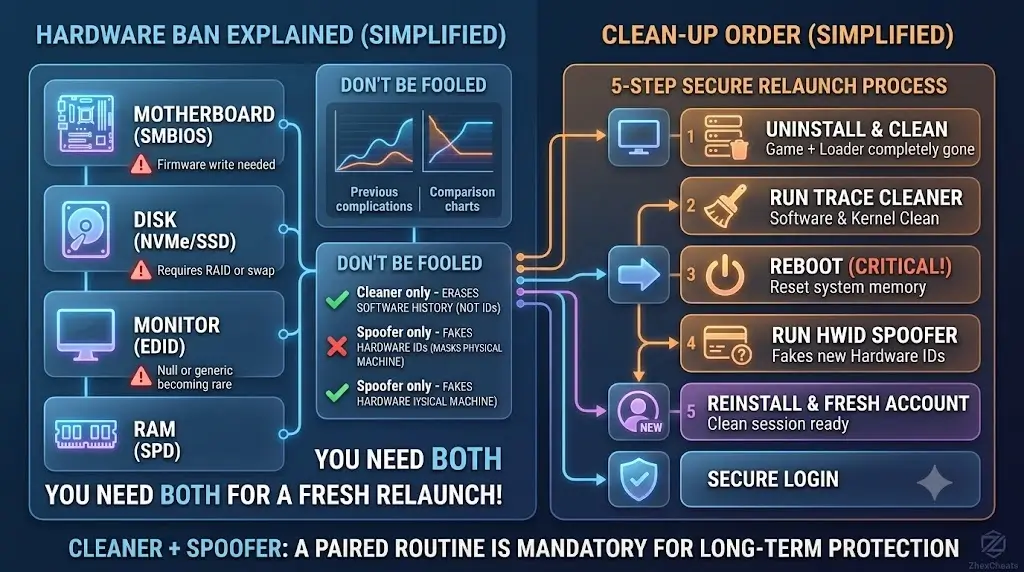
Hardware Bans Explained: Why a Software Spoofer Is Not Enough
A hardware ban fingerprints eight different components, from motherboard SMBIOS to monitor EDID. Here is what each layer actually checks and what closes the gap.
Jul 14, 2026Nathan ReedArtikel lesen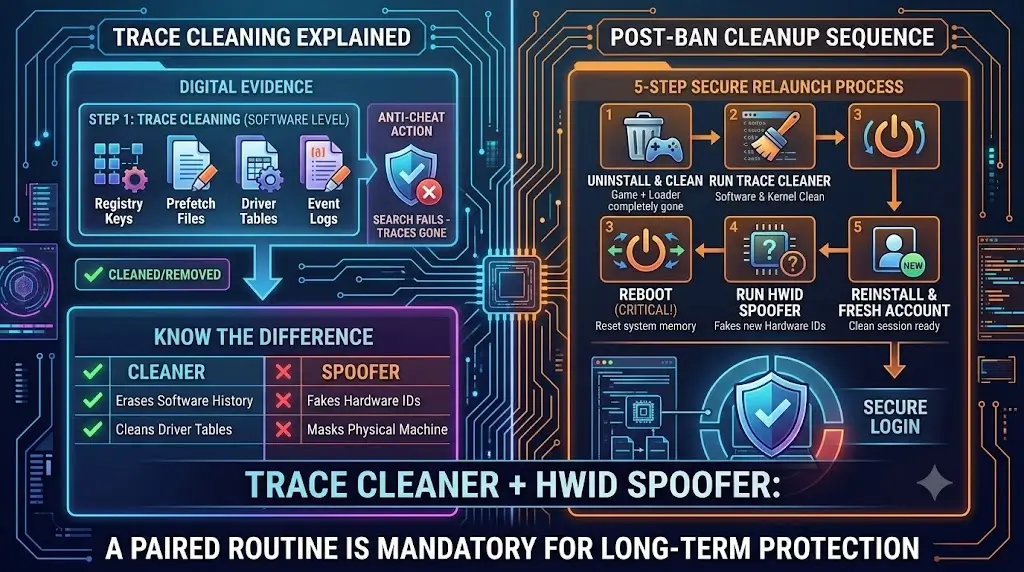 Game Hacking Guides
Trace Cleaning Explained: What Stays on Your PC After a Ban
Registry keys, prefetch files, driver load history: the records anti-cheat reads after a ban, and why a cleaner and an HWID spoofer are not the same tool.
Jul 14, 2026Nathan ReedArtikel lesen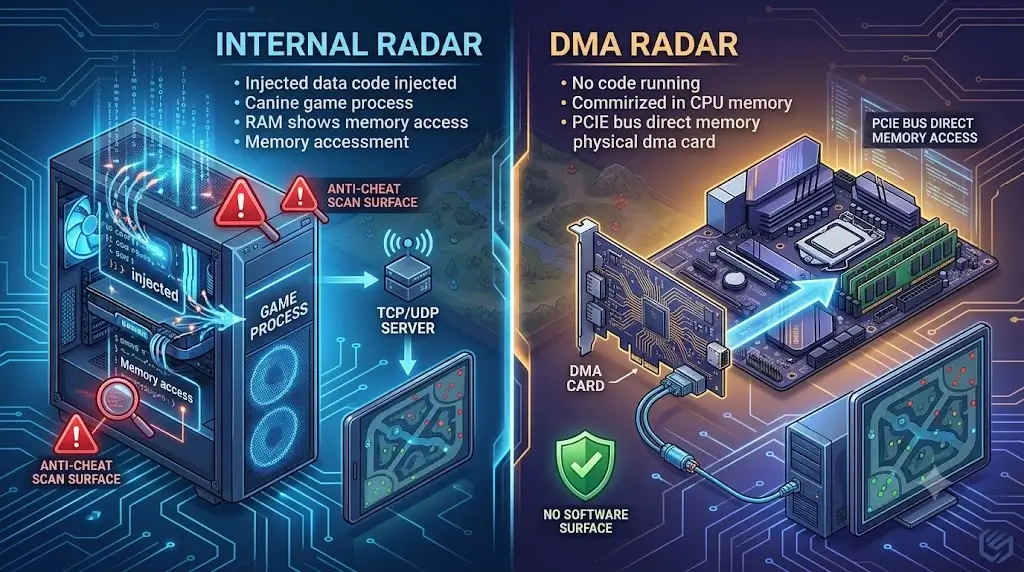 Game Hacking Guides
Radar Hack Explained: How the 2D Map Reads Every Player Position
A radar hack draws a second map that shows every player on the server in real time, without touching the game's renderer. Here is how it actually works.
Jul 12, 2026Nathan ReedArtikel lesen Game Hacking Guides
How to Read a Cheat Vendor's Ban History (And Spot Fake Logs)
Days-undetected counters, patch logs and testimonials are trivial to fake. The eight signals that separate real vendors from rebranders.
Jul 11, 2026Nathan ReedArtikel lesen