ABI Does Not Run One Anti-Cheat. It Runs Two.
Most games pick a lane. BattlEye or EAC. Vanguard or Ricochet. Arena Breakout: Infinite runs ACE and BattlEye simultaneously, and that combination behaves differently than either system on its own.
I spent 30 days running cheats through that dual layer, on the same account, tracking what flagged, what did not, and exactly when. This is what the data showed.
Two Systems, Two Jobs: Why the Combination Is Different
The first thing to understand is that ACE and BattlEye are not doing the same job from two angles. They cover entirely separate detection ground.
BattlEye operates on signature and integrity. It loads at the kernel level, scans running processes against a signature database, and validates the game client's loaded modules on a batch schedule. It is looking for something it already recognizes. A binary it has never catalogued passes those scans without producing a flag. That is the window private builds exploit.
ACE, Tencent's system, approaches the problem from the other direction. It builds a behavioral baseline across your session: crosshair transition speeds to bone positions, input timing consistency, kill-to-movement ratios across the full raid. It is not checking what is running. It is watching whether you play like a human. The two systems never overlap, and that is exactly why running both is harder to beat than either alone.
BattlEye
Watches
What is running
Layer: Kernel (Ring-0)
Method: Signature + process integrity
Cadence: Periodic batch scans
Blind spot: Unknown binary signature
ACE (Tencent)
Watches
How you play
Layer: Kernel (Ring-0)
Method: Behavioral baseline + memory
Cadence: Continuous through session
Blind spot: Drift in long sessions
The practical implication: you can maintain a completely clean binary and still accumulate ACE flags if your settings are not calibrated. Tarkov runs BattlEye alone. A private build with no shared signature surface sits in a genuinely low-risk position there. ABI adds the second axis. That changes the math.
If the distinction between external and internal architecture matters here, the external cheats breakdown covers why it affects detection surface in kernel-scanned environments like ABI.
Week 1: BattlEye's Window, ACE's Patience
ACE does not fire immediately. The first week of a fresh account, the system is establishing what normal looks like for you before it starts comparing. Behavioral confidence requires a sample size, and a few short extractions do not give it enough.
BattlEye's scan intervals are not continuous either. Integrity checks run in batches, which creates windows where module activity does not produce a detectable signature. Public builds do not know when those windows shift because update schedules are not disclosed. Private builds follow an internal maintenance cycle timed around exactly this.
Week one on the private build: three extraction raids, two custom lobbies, Loot ESP and Radar on, aimbot off. No flags. Clean session history. The setup that produced this result is what the ZhexCheats Arena Breakout module ships as default: smoothed aim, conservative FOV, information features active, aim features held back for the first sessions to build a clean behavioral record.
Week 2: Session Length Is ACE's Real Weapon
Normal ABI extractions run 20 to 35 minutes. Longer sessions give ACE significantly more behavioral data per run. A 20-minute raid is a sample. A 50-minute run is a pattern. The longer ACE watches, the more confident its comparison becomes.
Ranked mode added a second problem on top of session length. Ranked lobbies carry higher report frequency from other players, and reports accelerate how quickly a flagged account moves up the processing queue. Two things converging: ACE building statistical confidence, reports pushing the account into review faster.
// 30-day detection timeline
Week 1 · Clean
Private build, Loot ESP + Radar only. ACE building baseline. BattlEye finds no signature. Zero flags.
Week 2 · First Warning
Ranked plus long sessions. ACE detects behavioral drift. One anomaly event written to account record. Aimbot pulled from ranked.
Week 3 · Public Build Flagged
Test public binary entered ACE database within 18 hours. Shadow lobby behavior started on that account.
Week 4 · Ban Batch, HWID Match
Ban landed 61 hours after flag. New account on same machine, no spoofer, matched hardware within one session.
Ranked aimbot is the highest-risk configuration in ABI specifically because of the replay review system combined with ACE's session-length baseline. Kill angles and aim behavior get logged for later review. Playing at full lock in ranked with high-visibility kills builds a report pattern that accelerates flag processing. I pulled aimbot off ranked completely after week two. Risk is real.
The replay and spectator dimension connects directly to what the streamproof article covers: how recording systems intersect with behavioral review, and why overlays that do not appear on screen still carry indirect risk through play pattern analysis.
Week 3: The Flag You Do Not See Coming
The test account received its first flag in week three. Not through an immediate ban, through behavioral tells. Matchmaking times increased. The account started drawing lobbies with a statistically higher density of other flagged players. Shadow lobby behavior: the kind that does not appear in any notification but shows up in who you are queuing against.
The binary that produced the flag was a public build I ran deliberately to measure detection speed. Public ABI cheats distribute identical signatures across every user who downloaded that file. ACE catalogs shared executables through the sample pool that builds whenever multiple accounts run the same binary. BattlEye adds it to the signature database from the same data. Both systems converge on the same target from different directions. That public build was in the detection database within 18 hours.
The private build account was clean at the same point in week three. Same features, different compilation. That is the entire story.
Week 4: HWID Ban and the Identifier Stack
The flagged account received its ban in week four, 61 hours after the flag registered. Standard deferred batch timing. The flag is written first. The account action follows later, which means continuing to run the same binary after a flag extends the record without changing the outcome.
What followed the ban was the more instructive part. A new account on the same machine, no spoofer active, triggered a hardware match within one session. ABI's HWID system ties bans to multiple hardware identifiers simultaneously: disk serial, MAC address, motherboard UUID. A single spoofed value does not clear the hardware match because the system cross-references the full stack, not just one field.
The clean path back requires a full hardware fingerprint reset before the new account ever touches the game client. The HWID spoofer breakdown explains what gets replaced and in what order. The ZhexCheats spoofer handles ABI's specific identifier set across both layers, because BattlEye and ACE read from overlapping hardware sources and the replacement has to cover both.
What Stayed Undetected: The Settings That Worked
The private build account ran clean for the full 30 days. The configuration that produced that result is not complicated, but it requires discipline to hold when ranked performance is the goal.
| Module | Ranked | Unranked / Custom | What flags it |
|---|---|---|---|
| Aimbot | Off | FOV 8-12, Smooth 15+ | ACE behavioral + replay review |
| No Recoil | Off | On | Behavioral pattern, SVD analysis |
| Player ESP | On | On | No input data, zero trace |
| Loot ESP | On | On | No input data, zero trace |
| Radar | On | On | No input data, zero trace |
| Silent Aim | Off | Use carefully | Server-side angle inconsistency |
ESP and Radar carry effectively zero behavioral risk because they do not alter input data. ACE's behavioral layer monitors aim transitions and movement patterns, not information access. Loot ESP changed extraction value per raid significantly without touching any metric ACE monitors. Information features are the safest long-term configuration in ABI.
That distinction matters more than any feature list comparison.
ABI vs Tarkov: Is the Dual Layer Actually Harder?
Escape from Tarkov runs BattlEye alone. BattlEye is a capable system, Battlestate updates it seriously, but it operates on one detection philosophy: signatures and memory integrity. A private build with no shared signature surface sits in a low-risk position against a single-layer system.
ABI adds ACE on top. That second layer does not make detection inevitable. It adds a behavioral axis that a clean binary alone does not solve. You can pass every BattlEye check and still accumulate ACE flags through settings that are not calibrated to stay within human behavioral range. Tarkov does not have that second problem to manage.
The risk in ABI is higher in ranked, longer sessions, and with public builds. On private builds with settings discipline, the gap between ABI and Tarkov narrows considerably. If you run cheats across both titles, the Escape from Tarkov page covers how the single-layer BattlEye environment compares in practice.
30 Days, One Conclusion
ACE and BattlEye do not overlap. One watches what is running on your machine. The other watches how you play. That combination means two independent failure modes, and treating ABI like a single anti-cheat game is what gets accounts banned.
Private build, information features active in ranked, aim features held to unranked and custom lobbies, a spoofer staged before you need it. That is the configuration that ran clean across 30 days. Everything else is noise.
For the underlying mechanics behind why behavioral detection works the way it does, the behavioral biometrics article goes deeper into how systems like ACE build and compare baseline profiles across sessions.
// Weitere Artikel
 Arena Breakouts
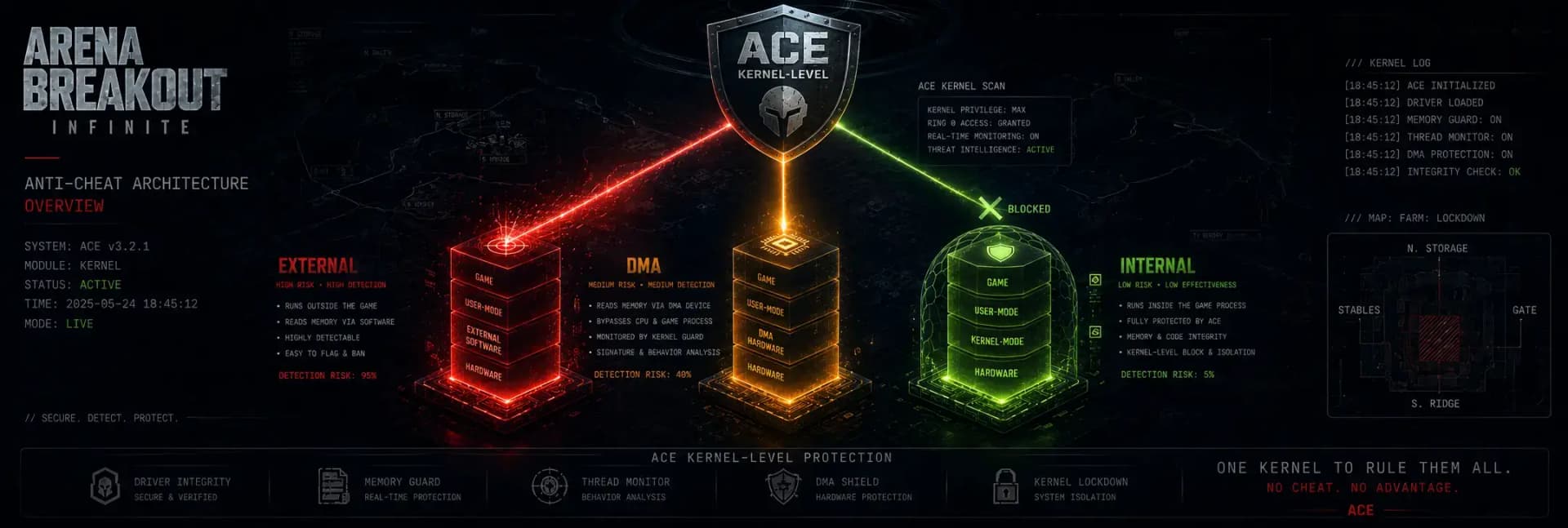
Arena Breakout Cheats Explained: Internal, External & DMA in 2026
Tencent's ACE treats Arena Breakout cheats differently than BattlEye does. Three architectures, three risk profiles, and the lane most players guess wrong.
May 28, 2026Nathan ReedArtikel lesen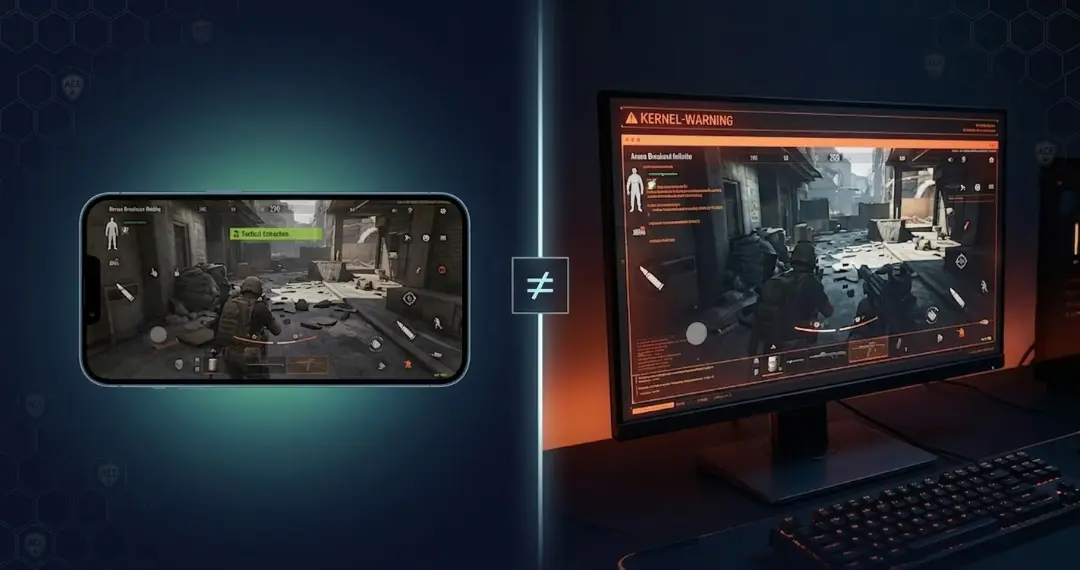 Arena Breakouts
Arena Breakout Mobile vs Infinite: Why the Cheats Do Not Cross Over
One name, two games, two completely separate cheat industries. What works on mobile dies on PC the moment it touches Ring 0.
May 28, 2026Nathan ReedArtikel lesen